


The car parking requirements changed in Victoria on the 18th December 2025. The new approach represents a fundamental shift to calculating parking requirements based on access to public transport rather than a flat rate that applies across the state. This means, a reduction in car parking rates in locations well-serviced by public transport and an overall net reduction in car parking requirements across Victoria.
Previously, a new develpment in a high street location had the same parking obligation as the same development in a residential street. Under the new regulation, sites benefiting from excellent public transport options will have a lesser obligation to provide parking.
Here is how it works:
- Every site in Victoria is now categorised (1-4) based on public transport availability with category one being the lowest access and category four being the highest.
- The parking rates are determined by the site category and the land use. Previously the rate was determined wholly by the land use.
- For category one and two sites, there are prescriptive minimum car parking rates.
- In category three areas there are minimum and maximum rates.
- Category four sites only have maximum rates, no minimums.
For sites in category one or two areas a permit will be required if the minimum parking requirements are not provided. For category three sites a permit will be required if either the minimum rate is not met or the maximum rate is exceeded and for category four sites a permit will only be required if the maximum rate is exceeded.
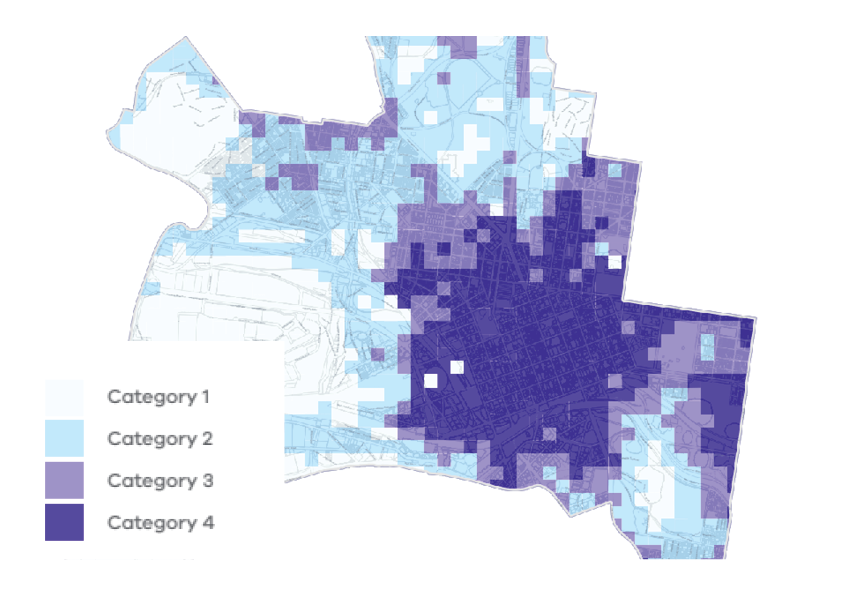
To explain using the ‘childcare’ example:
- On a category one site, the minimum requirement is one park per employee. A permit will be triggered if this requirement is not met and no permit is required if an applicant chooses to exceed this requirement.
- In category two, the minimum is 0.5 spaces per employee and no permit is triggered if an applicant chooses to exceed this.
- In category three, the minimum is 0.25 spaces per employee and there is no maximum rate specified for child care centers.
- In category four, no minimum or maximum rate applies meaning no permit is triggered and local council have no discretion to require car parking.
The state government do not want any further car parking introduced to sites with excellent public transport.
Other changes that have come in:
- Rates have increased for some land uses, an ‘office’ on a category one site now requires 3.5 spaces per 100 square metres of floor area compared to 3 spaces previously. Similarly, a new ‘warehouse’ now requires 2 spaces, previously 1.5 spaces.
- Deletion of some defined land uses and their associated prescriptive car parking rate. For example, ‘cinema’ and ‘bar’ have been entirely removed from clause 52.06.
- There has been consolidation of other land uses under more broader land uses. For example, previously, ‘restaurant’ and ‘convenience restaurant’ were separate uses. ‘Restaurant’ has now been deleted from clause 52.06, while ‘convenience restaurant’ continues to attract a prescriptive rate.
- New methodology of calculating parking rates. For example, child care centres now calculate the required parking based on number of employees rather than number of children.
- There is a transitional provision included that allows current applications, or applications lodged by the 16th June 2026 to continue to avail of the former version of the requirements if it is in the applicants’ interests.
Conclusion
- This is a fundamental shift in the starting point of the assessment of planning applications to ‘access to alternate modes of transport’ from ‘the nature of the use’. This is a good approach and consistent with human behavior as people will use alternate modes if parking supply is low.
- The introduction of permit triggers for exceeding maximum rates represents a fundamental shift for local councils who often are only concerned with minimums outside areas affected by parking overlays.
- Category four areas, where no minimums apply are exceptionally small pockets in the middle ring suburbs and nonexistent in the regional councils.
- Despite this, the formal introduction of maximum rates is good as it creates the concept of an ‘upper ceiling’ to parking supply which will be a new concept to many local councils and inform a more balanced negotiation.
- No new land uses and prescriptive rates have been introduced, meaning parking supply for business’ such as gyms remains to the satisfaction of the Responsible Authority. This means the adversarial situation most clients find themselves in with council and neighbor’s when they are occupying an existing site will continue.
- Despite this, the introduction of site categories and shift in focus to access to alternate modes of transport will likely assist many clients by informing the appropriate benchmark rate of parking supply for undefined land uses.
Do new rates apply for your development?
Can you avail of the changes to reduce your obligations and increase your yield?