

The COVID-19 pandemic has changed our way of life dramatically. As the pandemic continues, it’s impacting our community in many different and difficult ways. We have seen a lot of our daily activities going digital and online. Schools suspended all face-to-face teaching, doctors moved to consultations over the phone and majority of us are now working from home with meetings taking place over video conferences. All to protect the health and wellbeing of our community. These are unprecedented times and these changes are also happening within the Planning sector, especially VCAT hearings which traditionally rely heavily on face-to-face hearings. VCAT is currently closed to the public and can only limited amount of cases by phone during the coronavirus (COVID-19) pandemic.
Recently VCAT released two statements in relation to the process of VCAT hearings during the Coronavirus restrictions after new laws been passed this week, making procedural and process changes to enable the courts, corrections and wider legal system to continue to deliver vital justice services while complying with coronavirus related restrictions. This includes a temporary power to make further procedural changes by regulation, so that justice processes can be quickly adapted to changing public health requirements. You can read the full press release by the premier by clicking this link.
Victorian Civil and Administrative Tribunal (VCAT) has a very important role within Victoria’s planning environment. Ensuring VCAT can hear important planning and other matters remotely during this difficult time can ensure billions of dollars’ worth of projects can continue and keep the economy afloat.
As the Premier’s media release stated, work has already started on the $5.2 million upgrades required for VCAT hearings to go digital, which will be rolled out over the next 12 weeks.
The upgrades will include project management software, software programmers, software licenses, information technology hardware and digitisation and scanning of paper files. VCAT will also consider how these upgrades can also help ensure others matters can be heard digitally.
Only urgent matters have been scheduled since late March because of the coronavirus. This has meant that many current and pending matters, especially Planning and Environment List related issues were on hold since.
After the upgrades are completed and tested, VCAT stated directions hearings and less complex matters will generally continue to proceed by telephone. Video technology will only be used for suitable matters. All parties will soon be contacted by VCAT to advise if their matter is to proceed by telephone or video technology. Some matters may also be progressed ‘on the papers’ where possible.
With these matters able to proceed after VCAT gone digital, businesses and individuals will have certainty on their planning and development matters. These projects help create jobs and will support economic activity during the coronavirus crisis.
Frequently Asked Questions
Existing cases
Will my case still be heard?
VCAT is still hearing certain cases, primarily about residential tenancies, guardianship and some critical matters by phone. Other matters, such as planning permit related cases are deemed non-critical have been postponed to a future date to be set.
CS Town Planning are representing a number of clients in VCAT during the pandemic. From our experience, the hearings are likely to proceed “On the Papers” or being postponed to August 2020.
My case has been adjourned, what’s next?
VCAT is currently working out its schedules and how to proceed with these cases. At the moment, limited cases are heard telephone or “On the Papers”.
All parties will be contacted by VCAT to confirm if all parties are agreeable to proceed in such format. From our experience, some cases are better to proceed “On the Papers” to avoid delays.
My case is being heard by phone, what is the process?
VCAT will contact you to let you know the scheduled time for the hearing.
At the time of the hearing, VCAT will contact each party by phone on the number that the party has provided.
A phone hearing is no different to a hearing in person, so ensure you are in a quiet location and have any relevant paperwork at hand.
How can I pay my application or hearing fee?
Application and hearing fees are paid online or by post. Hearing fees can be paid from 4.30pm the day before the hearing. For more information, check fees at VCAT.
I want to change or withdraw my application. What do I do?
To change or withdraw your application, you must let VCAT know in writing.
New cases
Is VCAT still accepting new cases that do not involve residential tenancies, guardianship or other critical matters?
VCAT is still accepting any matters, such as planning permit approvals, that fall in VCAT’s jurisdiction.
CS Town Planning also remains operational throughout the pandemic to assist you with your planning needs or to represent you in VCAT.
Given the current circumstances are existing timeframes for applications still relevant?
Yes, current application time limits are still relevant. If you are planning to appeal a council’s decisions made for your planning application. Ensure you contact your town planner within the timeframe.
When will my case be resolved?
If your application is deemed critical, VCAT will schedule a phone hearing date with you.
If your application is not deemed critical your case will be adjourned (postponed) to be heard on a date to be fixed in the future.
At present, VCAT is unable to confirm precise timeframes for non-critical cases. From CS Town Planning’s experience, hearings are likely to be adjourned until August 2020.
When you look into the process of obtaining a planning permit for your project, no matter if it is residential subdivision or commercial change of use application, you may encounter a number of terms which you are not familiar with. In this post, our team have summarised some of the most frequently used terms so you can be more informed about the permit application process.
What is a property title?
A property title is an official record of who owns a piece of land. It can also include information about mortgages, covenants, caveats and easements affecting the land. When you purchase a property, you receive a Certificate of Title that confirms you are the owner of the property and indicates your registration in the online land register. (If you have a mortgage, the bank keeps the original Certificate of Title until you’ve paid off the loan.). In most cases you will need to produce the Certificate of Title when applying for planning permits in Victoria.
What is a covenant?
Covenants are noted on the property’s Certificate of Title. A covenant is a written agreement between the seller and purchaser of a piece of land restricting what the land can be used for. A covenant can date all the way back to when the property was first developed and be passed onto the current owner of the property. It is important to understand what covenant is in place when you plan to apply for a planning permit to develop and subdivide your property.
Some covenants will restrict your ability to develop on the land. For example, restricting the type of building material the purchaser can use or restricting the number of dwellings can be developed on the land.
What is an Easement?
Easements are drawn on the property’s Plan of Subdivision. An easement is a right held by someone to use land belonging to someone else for a specific purpose. Common examples of easements are drainage, sewerage and carriageway easements. At the design of your subdivision project, it is important to take these easements into account as it is quite often you cannot build on easements. Common ways to make the most out of the land which is affected by easements are to use these areas as Private Open Space or drive way.
What is an overlay?
An overlay is a planning control that seeks to ensure an important building outcome is achieved for a specific street, neighbourhood or area. A typical example is a Heritage overlay. A heritage overlay will identify specific heritage outcomes sought to be preserved or carefully monitored in a specific neighbourhood or street that is deemed to be of heritage value. Where a heritage overlay affects a property it can be difficult to obtain a planning permit for entire demolition of a building because the heritage overlay specifies that buildings should be retained. A more proactive example of the use of overlays is in areas identified for regeneration. If a street is identified as a good location for higher density buildings an overlay can be placed on the street that identifies preferred building heights way in excess of what currently exists. Planning authorities use these overlays to encourage developers to build higher density in areas that the government see as important.
What is a council request for further information?
After you have submitted your planning permit application, your local council may request for further information, an exercise that is common to most of planning applications. A Request for Further Information is likely to take form in receiving a letter from Council or an email If application was lodged online.
The information council requests may be traffic reports, arborist reports or other third party consultancy reports. A request for further information may also explain any concerns that Council has with your application. This stage is the chance where you can amend your plans to address these concerns that Council raised.
What is public advertising?
The Victorian planning system is set up to ensure that all affected parties of an application have the opportunity to comment on a planning permit, before a decision is made. Your local council planner will decide if and how public notification needs to be given. This stage is known as public advertising stage.
This could take the form of:
- Direct mail notification
- On-site signage
- Advertisements in the local newspaper
Your application will also be added to Council’s online register. If Council is satisfied that the application will not negatively impact anyone, public notification does not need to be given. If public notification is required, it must be carried out for a period of at least 14 consecutive days. During this period, a person can make a submission either in support or objection to the proposed permit. Anyone can lodge an objection to a planning permit application, although Council must consider all objections when assessing the application, objections need to have strong evidence to support the issues being raised.
What is an objector consultation meeting?
When you apply for a planning permit, there is a strong chance objections will be made to the proposal. Where a large number of objections are made a consultation meeting can be organised by Council and will usually occur at council offices outside business hours to give all parties an opportunity to attend. The meeting will often be chaired by the council planner or an elected councillor. There will often be a set agenda and there are opportunities for the applicant, council and the objectors to confer, ask questions and seek to negotiate for an acceptable outcome. The process can often be adversarial with the permit applicants often requested to make large concessions by both objectors and councillors. However, the meeting can be productive and should be attended by the permit applicant if organised by Council.
What is a referral authority and what is their role?
Some planning permit applications need to be referred to other authorities or organisations for advice and comment. For example, if you’re proposing to change the access to a road that is managed by VicRoads, your application will be referred to VicRoads.
The council will refer the application to other persons or bodies specified as referral authorities in the planning scheme. Referral authorities have 28 days to respond to the council. Some may object to the granting of a permit or specify conditions to be included on a permit. If a referral authority objects to your development then the Council is legally obligated to refuse your application.
What is a Notice of decision?
At the end of the notification period (if notice was undertaken), the council or responsible authority will assess the proposal and decide to issue one of the following:
- Issue a Notice of Decision
- Grant a pemit
- Refuse a permit
If there are objections during the notification period, council can only issue a Notice of Decision to Grant a Permit; all concerned parties will receive a copy of the notice.
The Notice of Decision to Grant a Permit doesn’t have the same legal status as a permit, but it signals council’s intention to grant the permit and identifies the conditions to be included on it.
An objector of the application has 28 days to lodge an application for review. If VCAT confirms that no application has been lodged within the 28 days council will than issue the permit. If an objector lodges an application for review within 28 days of the notice being given council can’t issue the permit. The application will then be decided by VCAT in a hearing.
What are endorsed plans?
Most permits refer to and are accompanied by a set of endorsed plans. Endorsed plans are a set of plans that shows all components and layout of a development. This set of endorsed plans form part of the permit conditions and will become subject to the permit. So long as that permit is relied upon, new development cannot lawfully proceed on the land unless the permit is amended or consent is granted for development to depart from that shown on the endorsed plans. A set of plans become endorsed when they are stamped by the council and the stamp clearly identifies the permit number which the plans are endorsed under.
Condition number one of the vast majority of permits issued by council will list a set of changes to be shown on plans before council will actually endorse the plans. Only on receipt of the plans showing the changes listed within condition one will council stamp the plans and they become endorsed as part of the official planning permit.
What is a secondary consent amendment?
A Secondary Consent Amendment is an application to your local council if you would like to make minor modifications to your endorsed plans. Under normal circumstances, most Planning Permits contain the condition:
The development as shown on the endorsed plan must not be altered or modified without the prior written consent of the Responsible Authority.
Your Planning Permit must contain the above condition, then you will be able to apply for an amendment under Secondary Consent. In addition to the above, there are other issues that should be taken into consideration when submitting an application for Secondary Consent Amendment:
- Your proposed amendment does not result in any amenity impacts and notification or public advertising is not required.
- You cannot alter or delete any condition or pre-amble of a planning permit under secondary consent provisions.
- The proposal does not result in a transformation of the development.
- It does not authorise something for which primary consent is required under the planning scheme.
- It is of no consequence having regard to the purpose of the planning control under which the permit was granted.
- It is not contrary to a specific requirement (or condition of the permit) as distinct from an authorisation within the permit, which itself cannot be altered by consent.
If your proposed amendment does not meet any of the above requirements, you will be required to apply for an Application to Amend a Planning Permit pursuant to Section 72 of the Planning and Environment Act.
What is a section 72 amendment?
After a permit been granted and you wish to:
- Make changes to the conditions on the pemrit or the pre-amble of what the permit allows
- Nake notable or significant changes to the endorsed plans that could impact neighbouring propertie
A Section 72 Amendment to a Planning Permit will be required. An application to amend a Planning Permit under Section 72 of the Planning and Environment Act follows the same process as a brand new Planning Application (including advertising and / or notification processes).
If you have a question about town planning jargon you would like to have translated do not hesitate to give our office a call and we would be happy to help.
No matter if you are opening up your first physical shop or giving your existing shop a fresh new design, the first contact you likely to make is often to an architect or a builder because the feeling of getting a design drawn up and seeing your idea slowly becoming reality is always exciting. But there is always one step many business owners forget about and often scramble to find help at the last minute. This important step is identifying required planning permits and obtaining approval from local council. All properties in Australia have some form of planning controls in place. The Planning scheme contains state and local planning policies, zones and overlays and other provisions that affect how land can be used and developed. The planning scheme determines if a planning permit is required to change the use of land or to construct a building or make other changes to the land. It is quite often that a planning permit is required to construct a building, alter a building facade or construct or carry out works. This means that all external works require planning approval. Some works also required to be to the satisfaction of the Referring Authority, such as Melbourne Water or VicRoads. It is worth keeping in mind that other controls (such as Design and Development Overlay, Heritage Overlay, Special Building Overlay and so on) within the Local Planning Policy may still require a planning permit for simple matters. The planning scheme also specifies relevant assessment criteria when a planning permit is required. In most instances, no matter if the work is as big as constructing a new building or as small as installing an advertising sign, it must be approved by the local council through the planning permit application process.
The Best Starting Point: Speak to a Town Planner
A town planner with experience in obtaining building or planning permits can provide you with advise on what types of permits and approvals you’ll need when you want to set up or make fit-out changes to your retail shop, office, commercial or business premises.
Common planning and building permit applications:
Situations where you’ll probably need a planning or building permit for a shop or commercial premises are:
- setting up your store, food premises or other business
- changing the existing shop front
- attaching signage to the building
- updating the internal fit-out of your premises
- putting outdoor seating or heaters on a footpath.
Each councils often have specific requirements for different type of businesses. It is important to understand the council’s requirements before you commence work. Heavy penalties will apply if council finds out the use of the premises or the building works have not been approved.
Preparing for the application
Each Council will often have their own specific requirements and checklists, so it’s important to have professional assistance in the early stages. A professional town planner will be able to confirm and check the requirements before you submit an application. You’ll need to provide different information for different types of permit applications. That might include site plans, elevation drawings or a written report. This information will need to be at professional town planning standard for council to conduct assessments on. A professional town planner will be able to justify your business in a way that council will be more likely to support your business idea, especially if you are applying for a Change of Use permit, leading to a more seamless approval process.
If your business is likely to draw high amount of traffic or your customers are expected to commute via personal vehicle, it is important to prepare a traffic report that addresses council’s concerns. Advertising signs or other form of signage quite often assessed under a different part of the planning scheme. Having a town planner to assist you earlier on, can identify all the requirements right from the start and help you to prepare what is required for you to get your dream design approved.
Below outlines the different stages your town planning application will go through after it has been lodged to Council.
Request for Further Information
After your town planner lodges the application, the planning officer of the council will check it and advise you (in writing) if further information is required. This stage is called Request for Further Information stage, this request is common and 99% of applications will go through this stage. If they do, they will contact your town planner who will then be able to work with you and your other consultants to gather all the required information and provide them promptly to the council. If the information can’t be provided in time, the application won’t be processed further.
Notice of a planning application (advertising)
This stage occurs unless the council is satisfied that granting a permit won’t cause material detriment to any person, or the planning scheme states that notice isn’t required. Council determines what notice should be given. They will let the applicant know which notice method is required, and explain what you need to do.
Notice of an application might be given via:
letters mailed to the owners and occupiers of adjoining / nearby properties (some councils require letters to be sent to owners and occupiers by registered post and others provide a mail-out service for permit applicants)
- sign(s) erected on the land subject to the application
- notice(s) in local newspapers
- notice to adjoining municipalities and / or government authorities / organisations or utilities.
Through this process, neighbours are informed about a proposal and invited to inspect the plans. Other parties can object to your proposal at this stage and a town planner can assist you in addressing these objections.
Council’s decision
At the end of the notification period (14 days), the council or responsible authority will assess the proposal and decide to:
- issue a notice of decision
- grant a permit
- refuse a permit.
A permit can be granted with or without conditions, and a proposal can only go ahead if all conditions are met. For example, a permit for a restaurant might be issued on the condition that a certain number of car-parking spaces are provided.
The applicant and all objectors (if there were objectors) are informed of the council’s decision via a Notice of Decision or a Notice of Refusal. The notice will outline the next steps you can take. There are opportunities to apply to VCAT for a review such as if a permit condition is unacceptable or if council fails to make a decision in time.
Case Study – Telstra Melbourne Flagship Store, Bourke Street Mall, Melbourne
Telstra engaged CS Town Planning to successfully obtain planning approval from Melbourne City Council for their flagship store project. The project involved a successful negotiation with Council on the number of digital and illuminated signage elements that were proposed along the Bourke Street mall and the Swanton Street façade of the building.

Case Study – ANZ Branch
CS Town Planning provides ongoing assistance to ANZ and Lendlease to gain approvals for their branch fitout work across Australia.
Previously a disused shop, the scope of works at 47 Bulcock Street, Caloundra in Queensland included change of use, new signage, including illuminated under awning sign, an illuminated ANZ logo and an electronic sign. Each item required a different planning permit approval. We were successful and all the signs were approved.

If you are opening a commercial venture and would like to confirm if you do require a council permit please do not hesitate to give us a call.
Whittlesea Council will join the conflict-plagued South Gippsland Shire Council which was removed in June last year, after six resignations and the Casey City Council, which remains at the centre of an IBAC investigation, and now replaced by an administrator last month as the third council to be sacked by the States Government within 10 months. After an independent monitor been appointed for Whittlesea Council, Victorian Government made the decision on Tuesday to sack the entire council.
The drama unfolded in the end of 2019 as Simon Overland became the third chief executive to be sacked by the council in the last four years, amid ongoing allegations of bullying and intimidation of staff by some councillors. The Australian Services Union (ASU) recently wrote to the council to raise concerns of a “very toxic workplace culture”. The independent monitor been appointed after receiving specific complaints about the behaviour of councillors and other matters over a number of months. Later discovered Simon Overland is the fifth chief executive sacked by the council in five years.
According to ABC News, The Victorian Government has moved to sack the dysfunctional City of Whittlesea council, three months after chief executive Simon Overland was removed and an independent monitor installed.
Legislation was introduced to State Parliament on Tuesday this week to dismiss the council due to serious governance failures revealed by municipal monitor Yehudi Blacher.
Mr Blacher found the council went through five chief executives within five years and spent $500,000 on legal disputes. Also found that an intractable toxic culture has developed of infighting and division and internal bickering, which has led to the total collapse of governance at the Whittlesea City Council.
“This council has spent $500,000 in legal fees as a result of their internal bickering rather than spending money on the upkeep of infrastructure’.
“An example of that dysfunction is the fact that the council has had five different CEOs within five years — that’s a huge, massive turnover of CEOs. I’ve never seen that before.”
Mr Overland, who was Victoria’s police chief commissioner between 2009 and 2011, was Whittlesea’s fifth chief executive in five years.
He was sacked from his job in December 2019 amid allegations of bullying and intimidation of staff by councillors.
He held a number of senior positions with Victoria Police during Melbourne’s “gangland wars” and was called to give evidence during the recent ‘Lawyer X’ royal commission about his involvement in the use of lawyer Nicole Gobbo as an informant.
Mr Blacher, the municipal monitor, recommended the council be dismissed and administrators appointed until the 2024 local government general elections, or later.
Councillor welcomes sacking
Despite being told he would lose his job, Councillor Tom Joseph said he was pleased the council would be sacked. He said the council was beset with internal fighting and he accused some fellow councillors of “pork-barrelling”, and making decisions that were “not in the interests of the community”.
“We’re seeing wrong decision after wrong decision, costing millions of dollars,” Cr Joseph told ABC Radio Melbourne.
At the time of Mr Overland’s sacking, Cr Joseph described the council as “in chaos” and said the State Government’s decision was in the best interests of Whittlesea residents.
“The monitor found councillors have stopped acting in the best interests of the City of Whittlesea and recommended its immediate dismissal and replacement with administrators. We accept the recommendations,” Local Government Minister Adem Somyurek said.
Mr Somyurek said it was unfortunate that in his short tenure there had been three councils the Government had needed to sack.
The monitor’s report was due to hand down in June, but the monitor said ‘I’ve seen enough now, mid-March and the longer this circus continues the more the people in the City of Whittlesea are missing out’.
Council’s Future
Just like Casey Council which was sacked earlier last month due to alleged corruption in relation to property development and town planning in the City of Casey. The government will appoint an interim administrator to make sure the Whittlesea council functions are delivered once the councillors are removed from their positions. As for Casey Council, the Independent Broad-based Anti-corruption Commission continues to examine council decisions related to property development and town planning in the City of Casey as part of Operation Sandon.
Both Casey Council and Whittlesea Council are likely to be without democratically elected representatives for the next five years after the State Government passed legislation to sack the councils and install administrators until 2024. Whereas South Gippsland Council will have an administrator in place until a general election to be held in October 2021.
For a long period of time, there has been no mandatory requirement in place for solar panels in Victoria and no protection for them from overshadowing by new developments. Although permits are required for installation of residential solar panels and solar panel permit applications have become increasingly popular, guidelines on new solar energy facilities and how to assess them as part of the planning permit application process have fallen far behind. Unlike overshadowing of private open spaces that are currently regulated by clear perspective standards and objectives, solar panels have been left in the dark when it comes to regulating new developments and assessing their overshadowing impact.
In 2018, a practice note (Planning Practice Note 88 – Planning considerations for existing residential rooftop solar energy facilities) was introduced by the State Government with the aim of providing guidance when assessing solar panel related planning permit applications. However, Councils are still free to make their own assessment of planning applications as they see fit and do not necessarily have to take into consideration the impacts of overshadowing to solar panels as the practice notes were guidelines to explain best practice when assessing planning applications rather than mandatory planning requirements like ResCode, a planning permit refusal on the grounds of solar panel overshadowing would be extremely unlikely.
The issue of overshadowing of existing solar panels usually only highlighted to council by objectors who have solar panels on their roofs or solar hot water heating systems and are concerned about the impact of a new house being built. It is more commonly addressed at VCAT when a planning permit application has been refused or an objector has appealed a council’s approval of a planning permit. A recent VCAT case where an objector has appealed a council’s approval for a planning permit has been successful with part of the objection being the new proposed development significantly overshadows the solar panels on his property. The VCAT case been marks as a ‘Red Dot Decisions’, meaning the decision is significant and will become the benchmark for all future cases involving overshadowing of existing solar panels.
Background of the VCAT Case
The respondent of the case is seeking to obtain a planning permit from Manningham council to amend an existing planning permit involving extensions and alterations to an existing medical centre to allow its more intensive use by up to six practitioners which council has approved. The applicant of the case lives next door to the medical centre and seeks to overthrow the council’s decision. He submits that the impacts of the proposal have not been properly thought through and addressed by Manningham Council. In particular, the proposal has not properly responded to the features of the site and its context. The site is elevated above the applicant’s property and impacts the applicant in terms of overlooking, visual bulk and overshadowing of roof top solar panels.

The solar panels were placed on the west side of the roof to capture the afternoon sun. Supplementary information at 15 minute intervals for the 22 September and 22 June were prepared by the applicant:
Commencement of shadows over existing solar panels
| 22 September | 22 September | 22 June | 22 June | |
| Panel row | Lower | Upper | Lower | Upper |
| Existing conditions | 3:45pm | 4:15pm | 3:00pm | 3:30pm |
| Proposed conditions | 3:00pm | 4:30pm | 2:15pm | 3:15pm |
At the time council assessed the permit application, Manningham council determined the extent of additional overshadowing would not be unacceptable. The applicant asserts that the council could not have properly informed itself of the reasonableness of the proposal’s shadow impacts upon the neighbouring solar panels because the council did not have the supplementary shadow information described above or any details about the type of system installed when it determined the permit application.
Tribunal Assessment of Impacts on Solar Panels
The VCAT member assessed the permit application differently to Manningham Council and agreed with the applicant. Given no other specific guidance is available in the Victorian Planning Provision that might assist decision makers, such as planners of the council, in their exercise of discretion on this matter, plus the energy efficiency objectives and standards in clauses 54 and 55 of the planning scheme do not technically apply to this non-residential proposal. This leaves Planning Practice Note 88 as the main form of guidance for council planners. However, the practice note does not form part of the planning scheme and is neither a reference nor incorporated document.
The VCAT member also pointed out, there is no specific guidance either within Planning Practice Note 88, the Victorian planning scheme itself or local policy framework to help assess the extent of existing overshadowing, appropriateness of the panels’ location on an adjoining rooftop and the effect of overshadowing on an existing rooftop solar energy system. Importantly, in relation to understanding the actual effects of a development on the energy produced by a rooftop solar energy system – in other words changes to an existing system’s performance. Other than the general guidance provided by Planning Practice Note No. 88, there is no other specific planning scheme guidance to assist decision makers determine the acceptability or otherwise of overshadowing impacts on adjoining rooftop solar energy systems.
Where assessments are undertaken of overshadowing impacts as in this case and others, the Tribunal’s findings are frequently and superficially limited to the net change in shadow impacts rather than the actual effects on a system’s performance – that is, the net change to a system’s energy output. In many cases, the final assessment is primarily based upon or limited to the degree to which solar panels have been vulnerably sited on a rooftop relative to development proposals and the consequential change in hours of sunlight access they receive – as distinct from understanding the actual effects on a system’s performance. In the absence of suitable planning scheme guidance and more detailed information specific to the operating characteristics of the adjoining rooftop solar energy system. This means that any meaningful assessment of the proposal’s actual effects on the performance of the adjoining solar energy system cannot be made in this case.
Also pointed out by the VCAT member, the time of year chosen for assessing impacts and spread of hours for assessment throughout the day remain uncertain variables. Nor is there any guidance as to what might be regarded as a reasonable loss of a system’s overall performance – for example, in terms of reduced output as a percentage of average electricity generated over a specified period of time. This continues to make the assessment of proposals and most importantly their effects on existing rooftop solar energy systems and the reasonableness of those effects difficult to determine.
The absence of timely access to and ready availability of information about the type and operating characteristics of existing rooftop solar energy systems presents very real challenges for permit applicants formulating proposals and for decision makers tasked with assessing their effects.
For the full Case: Ramjee v Manningham CC (Red Dot) [2020] VCAT 1 (5 February 2020)
VCAT’s Suggestion
The VCAT member of this case suggested that clearer and more sophisticated guidance at a state-wide level should be introduced. Such guidance might as a starting point specifying suitable reference times (such as time of year and spread of hours) with consideration to the variable orientations of panels (whether north, west or east facing) and include more specific parameters on what might be regarded as an acceptable change in an existing system’s performance. Different standards might also be adopted for different strategic contexts. Desirably, these should also be supported in a secondary way by appropriate decision guidelines to assist the exercise of discretion and avoidance of ‘a one size fits all’ approach, thus allowing for nuanced and contextually sensible decision making.
Such guidance would create greater certainty about the issue of overshadowing of solar panels, in turn, benefiting all stakeholders in the planning process including responsible authorities and the Tribunal on review. It would also be of assistance to persons who are making decisions about suitable locations for the installation of solar panels on rooftops and whether to seek a review of decisions involving overshadowing of such systems. A more consistent policy approach would assist both developers and existing solar panel users and future users to understand their obligations and expectations in this evolving assessment area.
Effects on Future Cases and Council Decisions
Despite overshadowing of solar panels forming part of the argument in the abovementioned VCAT case and marked as Red Dot Decision, mandatory planning requirements in relation to overshadowing of solar panels in Victoria will continue to be absent until state government takes action and amend the current State Planning Policy Framework. However, the case will now become the benchmark for all future VCAT cases involving assessments of solar panels and VCAT members will refer to Practice Note 88 more often compared to previously. This in turn will require councils to include assessments against the practice note when forming their decisions.
Subdivision is a popular method of releasing the financial equity in your property. This article will break down the steps for you, explain the basics of subdivision as well as what you need to be aware of and the key features of the typical subdivision layouts.
Subdivision Process
Subdivision involves designing a development layout for your property that meets your local council’s town planning policy framework, and also complies with the regulations governing Victorian subdivision, commonly known as ResCode. The local regulations vary from Council to council meaning that a subdivision proposal in the Monash or Boroondara Council area may not receive support in neighbouring Whitehorse Council or nearby Banyule Council or Glen Eira Council. It is important to engage a professional with local experience before commencing to avoid common pitfalls.
There is no one Council that is more ‘difficult’ to work with than another to get a subdivision approved but it is true to say that the processes vary between each so you should engage a professional firm with local experience and relationships. You can read some of our success stories by cicking here or visting our subdivision section. Once we have obtained subdivision consent from your local council we must then connect the newly created block(s) to the sewer, electric and water infrastructure.
Typical Subdivision Lot Layouts
Depending on the lot arrange of the property, there are three common layouts for two dwelling subdivisions.
Existing Dwelling with One New Dwelling
Typical Lot Arrangement with one existing dwelling at the front of the property with space to subdivide and develop at the back of the property. Both dwellings will be serviced by one single existing accessway.

Key Point 1:
Rear private open spaces are required for both existing and new dwelling. It is important to confirm the required size with the local council and local planning scheme.
Key Point 2:
Proposed subdivision line will be drawn on the edge of both dwellings and a common drive way will be created.
Key Point 3:
New double garages for each dwelling. State Planning Scheme typically require minimum of 2 car spaces per 3 bedroom dwelling.
Key Point 4:
Common driveway will require minimum of 75 square metres to allow for vehicle turning circles.
Key Point 5:
Driveway is required by the planning scheme to be 3 metres wide at minimum.
Key Point 6:
It is recommended to have 500mm – 1 metre landscape buffers on either side of the driveway. This will help maintain the neighbourhood characteristic and is widely accepted by local councils
Key Point 7:
Street trees, lights, local authority services may impact the proposed crossover location. Confirm relocation of service may be required at developer’s expense during permit application process.
Two New Dwellings Side by Side
Some designs consist of two new dwellings side by side with both dwellings having their own street frontage and direct access to the road from garage. New accessways will be required and each dwelling will have its own private driveway.

Key Point 1:
Rear private open space are required for both dwellings to comply with ResCode requirements. It is important to confirm the required size with the local council and local planning scheme.
Key Point 2:
Proposed subdivision line will be drawn in the middle of the dwellings, usually a single solid wall.
Key Point 3:
New Single garage plus one tandem car space for each dwelling. State Planning Scheme typically require minimum of 2 car spaces per 3 bedroom dwelling.
Key Point 4:
The design will propose slight variation to front and rear setback to both dwellings. The aim is to create its own identity for each dwelling and avoid mirrored designs.
Key Point 5:
Driveways are required by the planning scheme to be 3 metres wide at minimum.
Key Point 6:
It is recommended to have 500mm – 1 metre landscape buffers on either side of the driveway. This will help maintain the neighbourhood character.
Key Point 7:
Street trees, lights, local authority services may impact the proposed crossover location. Confirm relocation of service may be required at developer’s expense during permit application process.
Key Point 8:
First floor takes shape of “wedding cake” design to comply with local planning scheme and ResCode requirements.
Corner Lot with One New Dwelling on the Side
A major advantage of a corner block is that each dwelling will have greater sense of privacy and identity. Each dwelling will have its owndriveway access points and both dwellings remain separated from each other. Corner sites are often refered to as the easiest type of subdivisions for this reason.

Key Point 1:
Rear and side private open spaces are required for both dwellings to comply with ResCode requirements. It is important to confirm the required size with the local council and local planning scheme.
Key Point 2:
Proposed subdivision line will be drawn in the middle of the original lot, usually in between the garages of the dwellings
Key Point 3:
New double garage for new dwelling. State Planning Scheme typically require minimum of 2 car spaces per 3 bedroom dwelling.
Key Point 4:
New single garage plus a tandem car space for existing dwelling. Requirement of minimum 2 car spaces per 3 bedroom dwelling remains applicable to existing dwelling.
Key Point 5:
Front setback to compliant with ResCode and confirm with local council if there are any overlay controls.
Key Point 6:
It is recommended to have 500mm – 1 metre landscape buffers on either side of the driveway. This will help maintain the neighbourhood character.
Key Point 7:
Street trees, lights, local authority services may impact the proposed crossover location. Confirm relocation of service may be required at developer’s expense during permit application process.
What happens after Council approve a planning permit for subdivision?
As the owner who benefits from the value of a newly created block of land it is important that you be aware that you must pay to connect the newly created block(s) to sewer, electricity and water infrastructure prior to the sale of the land. This connection process and the cost cannot be passed to a purchaser of a new block and the connection process must be completed before the new title for the block can be released. Our experts have completed this connection process on behalf of our clients in a number of metropolitan suburbs. We will ensure your connections and processed in an efficient manner which will save you time in completing the project.
Meeting Conditions on your Planning Permit
When all of the conditions of your council-issued planning approval are met, we can then obtain property titles for the newly created lot(s). Titles cannot be obtained until all conditions of your Council approval are met. The conditions on your Council approval will vary from Council to Council but our team know the conditions of Monash Council, Boroondara Council, Whitehorse Council, Banyule Council and Glen Eira Council intimately and can tell you exactly what is required to obtain the titles for sale. On obtaining titles this land can then be sold to a new owner or held by the current owner for investment purposes.
Get Assistance with Subdivision Planning Approval
There are various elements to be considered when subdividing land or buildings. These include:
- Real estate prices in your local area to determine whether the project will be profitable;
- Knowing the associated application costs of the Council and the infrastructure connection when completing a subdivision;
- An effective development layout so that the maximum value of the land is achieved;
- Being aware of any existing site features, such as trees and easements, which may restrict the subdivision potential of the land.
Remember, you can’t legally sell each of the new lots (even off the plan) in Victoria until the title for the new lot is released to your lawyer or conveyancer. To get the title released it is not enough to merely get your subdivision approved, you must then meet all of the conditions attached to that approval. If any one of the conditions attached to the approval of the subdivision is not met your title will not be released and legally there will be no sale allowed.
Ensure you understand each of the conditions attached to your approved subdivision and get on with meeting the conditions as soon as the approval is issued. This is extremely important if you have a buyer lined up subject to the title being released because the longer they have to wait for the title the greater the risk they will pull out of the arrangement.
One tip in closing is to make sure to complete the subdivision within the time limits. An approved subdivision does not run indefinitely on the site so make sure to complete the project within the time frame on the planning permit to avoid having to reapply and pay the fees again.
Our team has the vision, creativity and demonstrated industry experience to exceed your expectations and deliver a fantastic return on your investment. Take the stress out of your subdivision project by letting our experts complete the project efficiently and successfully.
The Andrews Government made a decision at a cabinet meeting on 17th Feb to sack the entire City of Casey Council amid controversial town planning decisions. Legislation is expected to pass by both houses of State Parliament. An interim administrator would be appointed to the council until 2024, the next eligible election for the council.
For months the Independent Broad-based Anti-corruption Commission has been examining council decisions related to property development and town planning in the City of Casey as part of Operation Sandon. It heard property developer John Woodman allegedly paid at least $1.2 million in bribes to former Casey mayors Sam Aziz and Geoff Ablett in a bid to win planning approvals for his clients.
Former mayor Sam Aziz, who is in Egypt on extended paid leave from his councillor position, allegedly received more than $900,000 from Mr Woodman. Councillor Geoff Ablett, a Hawthorn premiership player and brother of AFL legend Gary Ablett Snr, is accused of receiving more than $330,000. Former state Liberal MP Lorraine Wreford was hired by Mr Woodman as a lobbyist, and has been accused of delivering bags of cash to the councillors.
The investigation into Casey by IBAC has sparked internal reviews at Mornington Peninsula Shire, City of Kingston Council, Whittlesea council and Frankston Council to look into its own town planning decisions and approvals.
Mornington Peninsula Shire
Mornington Peninsula Shire mayor Sam Hearn said the council would conduct a review of planning applications and decisions. He noted the review could also examine decisions made by past state planning ministers.
“We want to show that we are here for the good of the whole community, not a small sector of property developers,” he said. “Even if that means going back and exposing historical situations and occurrences that weren’t up to standard.” The town planning approvals process is heavily politicised and the scandal engulfing Casey is causing a number of councils throughout the state to examine the town planning approvals process for large developments, rezoning and subdivisions.
Whittlesea Council
Whittlesea council will audit all applications and approvals of commercial and retail developments and residential developments comprising more than five dwellings that have been submitted to the council over the past five years. The probity audit will be carried out by the council’s audit and risk committee.
Whittlesea councillors have asked for the audit and risk committee to list any developments with which a number of individuals who have been named in the IBAC hearings were involved. Councillors have requested a list detailing the date of the development application and approval; what rezoning or planning permit application was involved in the development; and the names of lobbyists, town planners, property developers, landowners or other individuals who made representations to the council about the developments.
If needed, the council will seek advice about referring the committee’s findings to IBAC. Cr Lawrie Cox said the audit was necessary because the council was aware of a company named in the IBAC hearings being involved in developments in Whittlesea. “This is about making sure things are above board, and if not, giving them to IBAC to be cleared up. We need to get ahead of the problem rather than sit back and let it steamroll.” he said.
Kingston Council
Kingston council also commenced special audit of all development approvals from the past 15 years. The Kingston audit will also probe four specific projects in Kingston since 2004. Ms Wreford, who the IBAC hearings revealed had handed envelopes stuffed with cash to Casey councillor Sam Aziz, was from 2010 to 2014 the state MP for Mordialloc – a seat that is almost entirely within the City of Kingston.
Former Defence land in Mentone, which was once used as parkland and known as Chicquita Park but later redeveloped as housing, will be analysed in Kingston’s audit, as will the Waterways estate, a project on a low-lying floodplain that Mr Woodman was key to developing. The Kingston probe will also look into a Chelsea Heights rezoning mentioned in passing by witnesses at the IBAC hearings.
The anti-corruption commission is investigating allegations that Mr Woodman, a multimillionaire developer and planner, used Mr Staindl to gain direct access to state Labor MPs over his rezoning applications. Mr Staindl, who will give evidence to IBAC this year, also lists among his clients Alex Fraser Group – Recycling. Mr Staindl has been advising the company on its political strategy over a controversial glass and concrete crushing facility it has on land in Clarinda that is zoned green wedge.
A million tonnes of glass and building rubble are recycled at the site each year, and the company has been lobbying since Labor approved the recycling facility in 2008 to be allowed to stay indefinitely. Council officers have recommended against it.
Kingston councillor Rosemary West successfully pushed to audit projects involving Mr Woodman and others. She said the recycling company’s application should be viewed with scepticism. Given the revelations at IBAC about potential corruption involving lobbyists with close links to the Labor and Liberal parties in planning applications, particularly on land zoned “green wedge”, she said it was crucial Mr Staindl’s role in that application was made public.
“I hope this enables us to learn what other developments were driven by these individuals, and what they may have done to persuade the council and perhaps the state government to support inappropriate developments, particularly in the green wedge,” Cr West said.
Frankston Council
Frankston Council is also looking into whether developers embroiled in the IBAC investigation into alleged corruption at Casey Council have lodged applications in Frankston. The report will detail “whether any of the property developers or named actors have had applications lodged in Frankston or have had representations made to Frankston City Council, what increased processes Frankston City Council could implement to ensure that the allegations vis-a-vis Casey City Council do not occur at Frankston City Council, and what additional future processes (if any) will Frankston City Council consider to further strengthen and protect its planning decisions.”
Councillors also ordered that “a stocktake of planning decisions – recent (previous 5 years) and current – be considered as part of council’s next internal audit.” The move comes after a similar move by Kingston councillors, who agreed to take a closer look at applications approved by council that may have involved parties subject to the IBAC investigation.
IBAC Second Phase
IBAC commissioner Robert Redlich said the second phase of Operation Sandon would go beyond what happened in Casey Council. “[In 2020], IBAC will also continue to explore whether the use of professional lobbyists or planning consultants to lobby government at all levels has resulted in undue influence over planning and property development decision making within Victoria,” he said in a statement.
Among the IBAC inquiry’s stated goals is to take a very close look at the transparency and integrity of planning and property development decision-making within Victoria, including donations to political candidates that may result in possible corruption. It will also focus in on whether the use of professional lobbyists or planning consultants to lobby governments has resulted in undue influence over those making the decisions.
On Monday 17th Feb, an independent Planning Panel commenced for the hearing of the Amendment C148 proposed by the Monash Council. Following the footsteps of Frankston City Council, who successfully increased their public open space contribution rates, Monash Council proposed amendment C148, an amendment that is much heavier handed and is one of the highest of any council.
Amendment C148 proposes to increase the public open space contribution requirement for subdivisions of 3 lots or more to 10% cash, 10% land, or a mix of both. More on Amendment C148 can be found here.
In the Evidence statement prepared by Dr Marcus Spiller, supporting the City of Monash, Dr Spiller provided justification on why Council should adopt a rate 30 square metres of Open Space per person which in turn, translates to requirement of 620.72 hectares of Open Space in City of Monash by 2028. Ultimately arriving at the uniform 10% contribution rate for Monash. You can download the Evidence statement prepared by Dr Marcus Spiller here.
Supporting Salta Properties, Golf Road Project Development and Talbot Road Finance, Matt Ainsaar, Managing Director and founder of Urban Enterprise, been instructed to prepare an expert evidence statement and present at the Planning Panel hearing.
In Mr Ainsaar’s expert view, there are three main issues with the Amendment relevant to open space contributions:
- The appropriateness of the open space calculation method applied to determine the 30 square metres per person;
- The suitability of the provision standard of 30sqm per person; and
- The equity of applying a single rate to all land uses and areas within the municipality.
The appropriateness of the open space calculation method applied to determine the 30 square metres per person for subdivision
Mr Ainsaar first assumes the calculation for the open space contributions rate for the Amendment were to be accepted, in his view there are considerable issues and inequities that warrant changes to the proposed contributions rate.
The rate is calculated on the basis of an open space target of 30sqm per resident which applies to all residents in the municipality in 2028, including both existing and projectednew residents, yet the current open space provision in the municipality is 27sqm per resident. In other words, the methodology applied acknowledges that there is an existing shortfall or open space “gap” that applies to the 192,850 existing residents.
This means that the target quantum of open space requires an increase in the open space provision for all existing residents (of 3.5 sqm per existing resident) as well as a new provision of 30sqm per new resident. The effect of this is that, as a result of the Amendment, new development would be making both:
- A contribution of land to meet the needs of the development; and
- A contribution which would result in an increase in the overall open space provision for all existing residents.
Table below shows that of the 108.62 additional hectares of open space that the SGS report identifies as needed to achieve the target provision of 30qm per resident in 2028, 66.45 ha (61%) relates to the amount of additional land required to increase the provision of open space per existing resident.
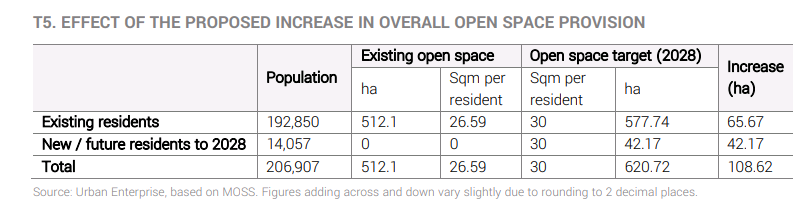
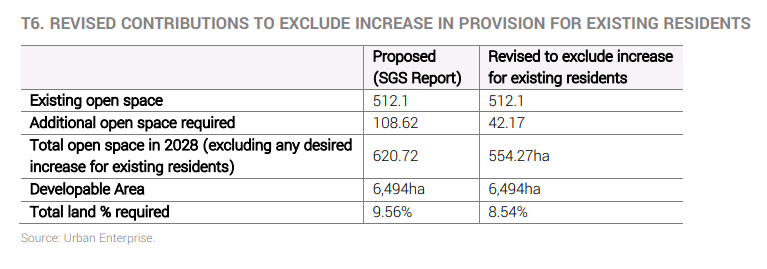
Mr Ainsaar believes it is inequitable for new development to be required to make a contribution to open space which is calculated on the basis of increasing the provision of open space for existing residents. If the method were to be recalculated to exclude the targeted increase in open space for existing residents, the outcome would be maximum contributions rate of 8.54% as show in the table below
The suitability of the provision standard of 30sqm per person for future subdivision town planning permits
Mr Ainsaar argues the Amendment relies on an open space provision target of 30sqm per resident which the Explanatory Report notes is “consistent with the provision of open space required in the planning for new housing in Melbourne’s growth areas”.
In his opinion, the Amendment adopts an overall open space provision target that is high relative to recently approved strategies and Precinct Structure Plans and which has insufficient regard to the population density and accessibility.
The SGS report shows that the provision target has been derived from a range of local, national and international examples which generally range from 20sqm to 30sqm per capita. The SGS report also notes that “A number of Melbourne based local governments apply a per capita provision rate to determine open space standards, and typically range between 24 and 30.3 square metres per capita.”
Mr Ainsaar reviewed the open space provision targets for four recent established area open space strategies in Melbourne, and four recently approved Precinct Structure Plans in Melbourne’s growth areas.

The provision standard adopted for Monash of 30sqm per resident is considerably higher than that recently adopted for activity centres in Kingston and Manningham (10sqm per resident) and is higher than the open space provision rate in recent growth areas (which ranges from 19sqm to 23sqm per resident).
Giving consideration to population densities increase, the provision of a specified quantity of open space per resident becomes less practical. Using Fishermans Bend as example, the open space strategy “sets a target of nine square metres per resident and worker, based on recommendations of the World Health Organization” The Planning Review Panel found that “The proposed quantity and distribution of open space in Fishermans Bend is broadly acceptable”. If a standard of 30sqm per resident were to be provided in Fishermans Bend, the 80,000 residents would require a total of 240 hectares of open space. This would take up more than 70% of the Net Developable Area in Fishermans Bend (340ha) which is clearly not a feasible outcome.
In his view, the selection of an open space provision target, if applied, should have regard to:
- The existing provision of open space;
- The existing and proposed population density; and
- A concurrent target relating to accessibility, so as not to solely rely on a quantitative target.
In the evidence statement prepared by Matt Ainsaar, he further points out Jells Park is one of the largest open spaces in the municipality, however this major park has been deducted from the calculation of open space provision per resident on the basis that it is classified as a regional open space. When Jells Park is included in the open space provision, the existing provision of open space per capita increases from 27sqm per resident to 41.25sqm per resident. This rate of provision comfortably exceeds Council’s own planning benchmark of 30sqm per resident. Despite not being a Council-owned open space, residents across the municipality, and especially in the eastern part of Monash, will clearly benefit from the availability of passive recreation opportunities in Jells Park and the broader Dandenong Valley Parklands. In his view, it is misleading to exclude Jells Park from the calculation of open space per resident.
Equity of applying the same rate to subdivision in all land uses
The Amendment proposes to apply a single open space contributions rate to all precincts across the municipality and all land uses, including residential, retail, commercial and industrial.
This would mean that, for example, an industrial subdivision in Mount Waverley would make the same contribution (in percentage terms) as a residential subdivision in Clayton.
The open space target on which the contributions rate is calculated relates solely to open space per resident. Although it is common for open space strategies to express open space provision in terms of provision per resident, in practice the open space also services workers, albeit in a different way
In his view, it is entirely inequitable for employment land uses to be required to make a contribution to public open space equivalent to 10% of the land area or site value when:
- The need for open space has not been demonstrated in the supporting material; and
- There is consistent evidence which demonstrates that the quantity of open space required to meet the needs of workers is considerably less than the quantity needed for residents.
Across Wyndham and Casey, open space contributions in employment areas are generally between 1.6% and 3.1%. In the municipalities of Brimbank and Greater Dandenong where there is considerable land for employment purposes, a lower contributions rate is applied to industrial (2% or 2.5%) than is applied to residential development (5%) as part of a municipal-wide approach to contributions.
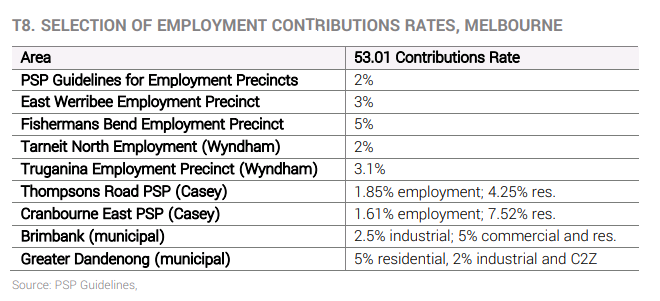
In his view, the MOSS does not provide sufficient justification to support the application of a very high rate of 10% to employment land in the municipality.
An alternative way forward
Mr Ainsaar concludes that the proposed rates should be set aside and replaced through a more robust, suitable and equitable method of calculating the contributions rate for subdivision. The Panel should also consider:
- There is no justification in the material supporting the Amendment for a public open space contributions rate for residential development higher than 5%; and
- The contribution for employment land uses should be lower than the rate for residential development – a contribution in the order of 2-3% would be appropriate.
Panel Hearing and other Evidence Statements
The independent planning panel hearing takes place from Monday 17 February 2020 and will go for 4 days.
City of Monash will present on day 1 and other parties to present on day 2 to day 4.
More information about the amendment, including the amendment documents and other evidence statements are available on the City of Monash website.
IBAC is holding public examinations into allegations of serious corrupt conduct in relation to planning and property development decisions at the City of Casey council.
The City of Casey, in Melbourne’s south-east, is Victoria’s most populous local government area and one of the fastest growing in the nation. It is home to more than 340,000 residents and includes the suburbs of Berwick, Narre Warren and Cranbourne.
The examinations are part of an IBAC investigation, Operation Sandon, into allegations of corrupt conduct involving councillors and property developers in the City of Casey in Melbourne’s south-east. The initial phase of the public examinations ran from 18 November to 6 December 2019. Examinations will recommence on 2 March 2020.
For months the Independent Broad-based Anti-corruption Commission has been examining council decisions related to property development and planning in the City of Casey as part of Operation Sandon. It heard property developer John Woodman allegedly paid at least $1.2 million in bribes to former Casey mayors Sam Aziz and Geoff Ablett in a bid to win planning approvals for his clients.
There is widespread speculation that Casey Council are set to be sacked by the state government as early as this week when laws to sack the council could be introduced to Parliament when it sits on Tuesday, with two councillors resigning ahead of the likely purge. Councillor Timothy Jackson and Cr Rex Flannery resigned from their post on 14 Feb 2020.”I no longer hold confidence in council’s ability to exercise decision-making to the standard that our residents expect,” Councillor Timothy Jackson said in a statement.
What is the story?
Cranbourne West Rezoning
Casey Council originally opposed the proposed rezoning of the Cranbourne West Precinct from industrial to residential land in 2014, but backflipped and supported it in 2015.The rezoning would have increased the value of the land by more than $100 million for one of Mr Woodman’s companies, Leighton Properties. The proposal is still with Planning Minister Richard Wynne.
Hall Road intersection
At the hearing of IBAC, it was revealed Cr Aziz pushed for the immediate construction of an intersection at Hall Road at Cranbourne West, against the advice of the council’s planning officers.
IBAC said the acceleration of the project would have delivered “windfall profits” for the developer Wolfdene, for whom Mr Woodman was working as a consultant, by “enabling it to develop land well ahead of the time it otherwise would have been able to”.
Pavilion estate
An amendment was moved by Cr Aziz last year to reduce the amount of open space required at the Pavilion housing estate and increase the amount of land being developed by Woodman-linked company Wolfdene.
John Woodman
John Woodman has been a prominent Melbourne property developer since the 1980s. He’s accused of paying massive amounts of money to City of Casey councillors so they’d vote in favour of his planning decisions.So far, the inquiry has heard evidence Mr Woodman and his associated companies gave Casey councillors Sam Aziz and Geoff Ablett $1.2 million. The commission heard Mr Woodman held $600,000 cash which was delivered to him in a suitcase from Cr Aziz in 2017, which Mr Woodman returned with interest, totalling $822,000. Some of the money was returned through payments to the bank accounts of Cr Aziz’s family members or funds to pay off his tax debts.
Cr Sam Aziz
IBAC alleges councillor Sam Aziz received $900,000 in payments from Mr Woodman or his associated companies over several years. The inquiry heard he was paid $80,000 by companies linked to Mr Woodman for his advice on plans for a satellite city at Little River, west of Melbourne. Cr Aziz is currently in Egypt and IBAC told the inquiry it didn’t know if Cr Aziz would return to face public hearings. The inquiry heard he sold his house after police searched his property as part of the investigation a month ago.
Cr Geoff Ablett
IBAC says former Hawthorn premiership player Geoff Ablett, a current City of Casey Councillor, received more than $330,000 from Mr Woodman or his associated companies.
The inquiry heard he received thousands of dollars in payments from Mr Woodman funnelled through Victorian horse breeder, Spicer Thoroughbreds, without the knowledge of the company’s owner who said the payments were “totally unauthorised”. Cr Ablett also received $15,000 in bank transfers from Mr Woodman either unsigned or under a fake name to pay off his credit card debt in 2014, before he ran as a Liberal candidate for the seat of Cranbourne in the Victorian election. Mr Woodman also bought a share of Cr Ablett’s land in Mountain View in eastern Victoria for more than $300,000.
Lorraine Wreford
The former state Liberal MP and Casey mayor was hired by Mr Woodman as a political lobbyist and was paid $5,000 a month. The inquiry heard she was also promised a trip to Europe for her and her boyfriend if the Cranbourne West rezoning project was successful.
Ms Wreford would deliver bags of cash totalling more than $100,000 from Mr Woodman to Cr Aziz as interest payments, the inquiry was told. The inquiry also heard Mr Woodman would only speak to Ms Wreford in encrypted WhatsApp messages and IBAC accused Ms Wreford of behaving like a “drug dealer” using code words such as “the package” to refer to the payments. She also referred to Mr Woodman as “the blood donor” when discussing him with Cr Aziz, the inquiry heard.
The examinations are part of an IBAC investigation, Operation Sandon, into allegations of corrupt conduct involving councillors and property developers in the City of Casey. The initial phase of the public examinations ran from 18 November to 6 December 2019. Examinations will recommence on 2 March 2020. If there’s found to be evidence of corruption, IBAC can bring criminal proceedings against the parties involved and it can also refer the matter to the Office of Public Prosecutions.
Following the footsteps of Frankston City Council, who successfully increased their public open space contribution rates, Monash Council proposed amendment C148, an amendment that is much heavier handed and is one of the highest of any council.
Amendment C148 proposes to increase the public open space contribution requirement for subdivisions of 3 lots or more to 10% cash, 10% land, or a mix of both. Currently, Council requires a public open space contribution of between 2% and 5% depending on the number of lots created. A contribution rate of 10% has been determined by council as necessary to deliver a reasonable standard of open space provision across the whole of Monash for a growing population. Council believes this contribution rate reflects the need to ensure that all future residents will have contributed to providing an appropriate level of public open space services and recognises a need of 30 square metres per person as determined by Monash Council.
Recently, an independent Planning Panel has been appointed by the Minister for Planning to consider the Amendment and all submissions that Council received about the Amendment. The Planning Panel Hearing for the Amendment C148 will commence on Monday 17 February 2020 and will go for 4 days. With the hearing commencing shortly, Evidence statement prepared by Dr Marcus Spiller, instructed by Maddocks on behalf of the City of Monash, been released on the council’s website for public to inspect and review.
Dr Marcus Spiller is a Principal and Partner of SGS Economics & Planning Pty Ltd (SGS), with academic qualifications of PhD in Global Studies, Social Science and Planning, Master of Commerce (Economics) and Bachelor of Town and Regional Planning. Dr Spiller specialises in metropolitan strategic planning, housing policy, urban infrastructure funding and the links between urban structure and national economic performance. Dr Spiller also has experience in providing advice to all tiers of government and the private sector related to the dynamics of housing, transport, employment, infrastructure and the general economy in cities.
Why Council adopt 30 square metres of Open Space per person
In the evidence statement, Dr Spiller first explains the rationale behind the need of 30 square metres of public open space services per person as determined by Monash Council.

In the table above, provided by Dr Spiller, Melbourne based local governments illustrate a range of open space rate between 24 and 30.3 square metres per capita, while other average open space rates under a range of other authorities are slightly higher than 30 square metres per capita. Therefore 30 square metres of open space per capita is considered a reasonable benchmark to apply in Monash. Despite this rate is towards the higher end of the range of possibilities, the adoption in Monash is justified in the context of climate change and community expectations of greater infrastructure investment to support urban consolidation.
Dr Spiller further adds, as at 2016, open space provision across the whole of Monash stood at less than 27 m2 per capita, which is already 10% below the standard adopted above. With no further addition to open space stocks, the open space rate will fall to less than 25 m2 per capita over the next decade. Therefore Substantial investment in the quantity and quality of open space provision in Monash is required to arrest this trend decline and build towards a reasonable standard of sufficiency.
Why council propose flat rate of 10%
To arrive at the uniform 10% contribution rate for Monash, the open space standard has been applied to all developable land in the City; that is, including land already developedas well as land that is likely to be developed or redeveloped over the planning period. Conceptually, his calculation method contemplates Monash as a blank slate and poses the question ‘how much open space would be required in the City by 2028 to fulfill an aggregate provision standard of 30 m2 per capita?’ This quantum is then divided by all developable land to give a ratio.

Dr Spiller argues that a 10% contribution rate is not unprecedented. In his opinion, historic practices in open space contributions in metropolitan Melbourne are no longer appropriate in the context of climate change and community expectations for additional investment in infrastructure to support urban consolidation. Contribution rates under the open space Particular Provisions in Planning Schemes have been increasing in recent years, with a number now featuring flat rates of around 8% covering large areas of municipalities. He regard this as a reflection of growing awareness that “business as usual” in open space contributions will no longer do and that substantially increased investment in the quantity and quality of open space is a pre-requisite for urban consolidation and a climate resilient city.
Impact on development in Monash
Dr Spiller believes the cost of the increased open space contribution will most likely be passed back in the form of lower bid prices for development sites rather than compression of developer profit margins or increases in dwelling prices. In many circumstances, the reduction in bid prices for development sites will still leave a substantial premium for land sellers so that they will remain motivated to sell to bona fide developers. There is a large pool of potential development sites in Monash. Only a small proportion of these sites needs to be released for development to achieve projected housing demand.He believes developers who have already acquired land for development but have not yet subdivided will be impacted by the introduction of a higher open space contribution rate as it will not have been incorporated in initial development costs assessment. Am C148 will affect development feasibility to the extent that it influences the profile of costs that need to be built into the RLV calculation, in particular the public open space requirement.
Impact on housing affordability
It is his opinion that the Gross Realised Value (GRV) of developments in Monash will not be affected by the introduction of Am C148 as Developers operate in competitive markets and are unable to apply a cost plus formula to dictate unit sale prices. They are price takers rather than price makers.
Therefore, he disagrees with those who claim that increase in the open space contribution rate will lead to dwelling prices increases. These prices will be determined in the wider market independently from the open space provision requirements in the Planning Scheme. The increased open space contribution will impact on the price developers are willing to pay for a development site, not on the price that development units are sold for, nor on the construction costs.
Dr Marcus Spiller’s Conclusion
Am C148 is critical to ensuring there is adequate open space in the future. The proposed amendment to require all subdivisions of 3 lots or more to provide a public open space contribution of 10 per cent will enable an adequate funding stream for City of Monash to ensure there is a sufficient standard of open space provision.
He believes AM C148 will not impact on housing prices in new developments. It may have a short term impact on landowners’ willingness to sell due to a change in the profile of development costs which sees residual land value becoming a smaller proportion of the gross realised value. But it cannot be assumed that this will forestall development.
Panel Hearing and other Evidence Statements
The independent planning panel will commence on Monday 17 February 2020 and will go for 4 days. City of Monash will present on day 1 and other parties to present on day 2 to day 4.
More information about the amendment, including the amendment documents and other evidence statements are available on the City of Monash website.