

Stonnington council have introduced a new process where developers must enter a deed of protection and provide a bank guarantee to secure the protection of significant trees and vegetation as part of their planning approval. The bank guarantee will apply to trees on the development site, neighbouring sites and nature strip that have the potential to be impacted by buildings and works.
Much like a security deposit the bank guarantee must be paid upfront by the permit holder once the planning permit has been granted. It will be a mandatory requirement as a condition of any planning permit where trees and vegetation are to be retained. The bank guarantee must be put in place before endorsed plans will be issued. The amount forfeited, and the conditions upon which the amount would be forfeited will be outlined in the deed. The council have informed current applicants that the amount of the bank guarantee required ‘is based on an arboricultural formula, which considers factors such as the size, health and structure of a particular tree’. They have not released any details on how much applicants can expect this to cost per tree or how close a proposed retained tree has to be to a proposed building to be considered subject to the protection deed and bank guarantee.
According to Stonnington this new measure will tackle the ‘serious and frustrating issue’ of significant trees being removed or damaged after a permit has been issued. The council have said that it is difficult to ‘reactively address’ this issue and that there are ‘too many instances where permit holders are not adequately protecting vegetation that is to be retained as part of a development approval.” The council hope that these guarantees will achieve “greater pre-emptive protection of vegetation in the future.’
Due to the high level of redevelopment there has been a loss of trees across the municipality. The increasing population, housing growth and competition for limited space have all led to the removal of urban trees and vegetation in the area. Therefore the council are now implementing these new measures.
They have said that developers must have high regard for protecting and retaining trees as wells as planting new vegetation as it is ‘often a critical determining factor to the issue of a planning permit’ The new controls seek to implement the Council’s Urban Forest Strategy which was adopted in June 2017.
How much will it cost as part of the planning permit approval?
The cost will be assessed on an application by application basis and will be calculated using the Burnley method. This method is a mathematical equation that establishes the dollar amount a tree is worth. It is calculated by multiplying the size of the tree, which is based on the height and canopy spread, by its retail price. It is also multiplied by four different modifiers which all have a specific value. These include tree size, useful life expectancy, form and vigour and location of the tree. For example large trees with a long life expectancy will cost more than smaller trees that are in poor health. The modifiers are used to minimise inconsistences in price depending on who values the tree. The cost will then be stated as part of the condition attached to the planning permit. The applicant must meet all costs associated with drafting and execution of the Deed, including those incurred by the council.
When there are ‘significant trees’ which may be affected by a new development an arborist will be appointed to assess them and establish a tree protection zone. This protection zone is a certain area around a tree that should not be encroached upon in order to protect the tree. In general councils allow developments to encroach on only 10 percent of the tree protection zone. If the development encroaches more than 10 percent then it is up to the applicant to establish how this tree will be protected.
When will the cost be returned?
Once a period of 12 months has lapsed following the completion of all works at the site the council can release the bank guarantee upon the written request of the developer. The council will first inspect the tree(s) and confirm they have not been detrimentally affected from the build. The deed puts the onus on the permit holder to notify council when the development has been completed and the 12 months has begun. A developer must write to council notifying them that a Certificate of Occupancy has been issued and that the 12 months can commence. A Certificate of Occupancy is issued by a building surveyor to confirm that the completed building work is suitable for occupation. This is a very long time for developers to wait before the guarantee is return and could see the money left with the bank for several years until the development is completed. However this seems to be part of the new stricter line from the council.
Zero Tolerance for planning permits
Stonnington have also stated that they will now have ‘a zero tolerance approach’ to developers who fail to follow the conditions of planning approvals that apply to trees and vegetation. Warnings will no longer be given to permit holders who fail to comply with conditions relating to tree and vegetation.
In their Tree Management Approach they state that “Any failure to fully adhere to these requirements will be cause for prosecution.”
If you have an application in the City of Stonnington that maybe affected by these measures please get in touch and we would be happy to provide you more information.
The minimum garden area requirement is a planning rule which applies a mandatory percentage to a residential lot that must be used as garden area. Being a mandatory requirement, it is essential that the rule is adhered to during the planning of a residential development. Failing to follow the rule even by a few square metres could see your development being refused.
A recent VCAT case is a useful example of why it is essential this requirement is met and what happens when it isn’t. Win 88 Pty Ltd v Manningham was an appeal against Manningham council after they had refused a planning permit for six new houses at Brindy Crescent in Doncaster East. The case was heard over seven months with three separate hearings on 12 September 2018, 15 February 2019 and 4 March 2019.
On April 5th the VCAT member announced their decision and the appeal was refused and the permit not granted. This was a severe blow for the applicant who engaged two town planners to represent them along with a landscape architect as an expert witness.
Manningham council’s refusal was based on the following
• Does not comply with the minimum garden area requirement of the GRZ1.
• Is fundamentally inconsistent with the existing neighbourhood character.
• Has had limited regard to the natural topography of the review site and surrounds.
• Fails to manage overlooking and visual bulk from properties and the public.
• Fails to respond to the Reserve in terms of visual and pedestrian connectivity.
• Provides a poor level of accessibility to dwellings.
• Fails to provide appropriate or acceptable secluded private open space (SPOS).
• Fails to provide a resolved car parking design.
Does The Proposal Comply With The Minimum Garden Area Requirements?
The most contentious issue was whether the development complied with the minimum garden area requirement. It was established that it didn’t and this is what ultimately lost the case for the permit applicant.
During the design stage the architect had not allowed enough garden area for each house. The site consisted of two separate lots in the general residential zone each over 650sqm. The proposed development fell under the provisions of clause 32.08-4 which required a minimum 35% garden area at ground level for each lot.
At the first hearing amended plans where substituted for the original plans to alleviate some of the planning concerns raised by Manningham council. But this was not enough to convince the VCAT member to approve the permit for the six dwellings.
It was identified in the amended plans that the deck areas and the porch entrance, which were thought to make up the percentage, were above 800mm from ground level and therefore could not be included in the calculation of minimum garden area. Therefore the revised plans submitted by the applicant was short of garden area by around 3.5sqm and the appeal was refused.
The decision can be seen as a hard line from VCAT as the proposal was less than 4sqm under the minimum requirement. This shortfall could have easily been corrected through a condition attached to the permit imposing that the garden area must be increased to meet the requirement. This is most likely what the applicant and their representatives were assuming would happen and is why they didn’t fully meet the requirement in their amended plans. The VCAT member stated in their order that there was ‘ample time and multiple opportunities to properly address this issue’ and thus decided to refuse the permit.
The council did acknowledge that the absent 3.5sqm was not a large area given the overall site size of 1557sqm. However it submitted that the clause does not provide for a variation to the required minimum garden area. It simply requires the relevant percentage to be met as part of the preparation of the application.
The decision echoes the council’s submission and reaffirms the mandatory and definitive nature of the garden area rule. A development either meets the requirement or it does not. There is no measure given to how close it comes to the requirement and if not met then the development will be refused.
Below are three tips on how to meet the minimum garden area requirement and make sure your development is approved.
1.Make sure you are aware of how much garden area is required. This is calculated based on the size of the lot. The larger the lot the more garden area is required.
Lot size Minimum percentage of the lot
400 – 500 sqm 25%
Above 500 – 650 sqm 30%
Above 650 sqm 35%
2.Know what can be included as garden area and what is exempt.
Understanding what can be included in garden area is very important and is where many development designs face problems. Including areas such as a driveway or a roofed alfresco to meet the minimum garden area will not be accepted by council. By including areas that are in fact exempt will lead to plans having to be revised.
Garden area is defined in Clause 72 of all planning schemes as:
Any area on a lot with a minimum dimension of 1 metre that does not include:
a) a dwelling or residential building, except for:
• an eave, fascia or gutter that does not exceed a total width of 600mm;
• a pergola;
• unroofed terraces, patios, decks, steps or landings less than 800mm in height;
• a basement that does not project above ground level;
• any outbuilding that does not exceed a gross floor area of 10 square metres; and
• domestic services normal to a dwelling or residential building;
b) a driveway; or
c) an area set aside for car parking.
3.Clearly show the garden area
When submitting plans to council as part of a planning application make sure they clearly detail the garden area of the site and include the percentages. Clearly demonstrating the garden area when submitting your application will minimize any discrepancies as to whether you have met the requirement when the council review the proposal.
Heritage Victoria have rejected a planning permit for a new Apple store to be built at Federation Square which would have seen part of the square demolished to make way for the new store.
The highly controversial project was set to be a global flagship store for Apple. Although having a smaller footprint than the Yarra building that it was set to replace it was described as creating 500 square metres of additional public space and better connections to the Yarra River and Birrarung Marr. It was thought it would revitalize the square and encourage more visitors. However the development faced major backlash from the public which has gone on for more than two years when the Victoria Government announced approval of the plans in December 2017.
Criticism came from what people saw as the commercialisation of a place intended for culture and arts. Along with the demolition of the Yarra building, which is part of the iconic square, to make way for the Apple store. The three-storey Yarra Building encloses the Square on its southern side and is beside the Yarra River. The Koorie Heritage Trust, which includes an Aboriginal art gallery is currently housed in the building and would have been relocated elsewhere in the square if the plans had gone ahead. A lack of public consultation before the plans were approved by the Victoria Government also contributed to the strong criticism.
Activist groups Citizens for Melbourne and Our City, Our Square have campaigned against the redevelopment of the square and helped accumulate over 1,100 submissions opposing the Apple store ahead of a council committee meeting to discuss the project in March 2019. The City of Melbourne’s Future Melbourne Committee ultimately decided to oppose the four storey Apple store. Only one of the eleven committee members voted in favour of demolishing the building without the need for heritage approval.
Federation Square houses the National Gallery of Victoria and the ACMI along with cafes and restaurants and was developed in 2002 to be a community hub of culture and arts representing the culmination of a century-long search for a public square in the centre of Melbourne. However it has been criticized in the past for its unattractive design and not being as popular a tourist spot and community hang out as once intended.
Planning Permit to revive the Square
Advocates of the flagship Apple store argued it would bring a new lease of life to Federation Square after user engagement and footfall has not lived up to expectations. The proposed Apple store would have been on a 21-year lease and been one of six flagship stores around the world. The plans went through several changes and was redesigned in consultation with Melbourne City Council to address concerns from the community and council itself but to no avail. Apple tried to emphasise the education and community engagement activities the store would bring to the square rather than being just another commercial retail space. However they were not prepared to compromise and house the new store in the Yarra building to save it from being demolished. They argued that the Yarra building in its current form was too small for the community activities planned for the store.
Heritage Register Nomination
To stop the development from going ahead and to save the Yarra building from demolition the National Trust of Australia Victoria stepped in and nominated Federation Square to the Victorian Heritage Register. This then triggered planning regulations that required Fed Square Pty Ltd, who manage the square, to apply to the heritage authorities for approval of the development.
On 1 August 2018, Heritage Victoria accepted the nomination to include Federation Square on the Victorian Heritage Register under the provisions of the Heritage Act 2017. Heritage Victoria made an Interim Protection Order over Federation Square and in December 2018, the Interim Protection Order was extended until 31 August 2019.
An Interim Protection Order ensures that any planning permit application for a nominated building has to be lodged with the Heritage Council of Victoria for approval prior to the decision being made to include or not include the place on the Victorian Heritage Register. A final decision as to whether it will be placed on the register is expected in mid-2019.
Planning Permit Decision
This gave Heritage Victoria the final approval over the new Apple store which they consequently rejected on April 5 2019 on the grounds of it being an ‘unacceptable and irreversible detrimental impact on the cultural heritage significance of Federation Square’. The refusal also noted that the negative impacts of the proposal to Federation Square far outweighed the economic benefits the Apple store would bring. The full refusal can be found here.
Simon Ambrose, CEO of the National Trust of Australia (Victoria) said it was committed to saving places of significance and Federation Square has come to be highly valued by the community on both a cultural and architectural level.
“With significant changes proposed at Federation Square, we have fast-tracked our nomination to ensure there is a coordinated approach which takes into account the architectural and cultural significance of this important place. Additionally, the lack of transparency has been concerning, with no attempt to consult Victorians—the very people who Federation Square was built for”
The nomination was questioned by some as Federation Square was completed only 16 years ago. It was argued whether giving the Square a place on the heritage register was justified for such a relatively new development and last year the Tourism Minister John Eren said it was ‘unprecedented’ for such a new build to be put on the register.
Apple have decided not to appeal the refusal which means that for now the Yarra Building has been saved. This demonstrates the many complications that can arise when lodging a planning permit application in areas of heritage significance. If Federation Square’s nomination is accepted by Heritage Victoria and it is added to the register it will ensure the continued protection of one of Melbourne’s most significant public places.
Frankston Council is seeking to make public open space contributions mandatory for future subdivision applications made in the municipality. Amendment C127 has been proposed by Frankston Council which will include an increase to contributions rates in higher density and activity areas. This amendment to the Frankston Planning Scheme will apply to all land in the Frankston Municipality.
The proposed changes will amend Clause 53.01 of the Frankston Planning Scheme which previously did not specify an open space contribution rate. Frankston currently collects open space contributions under section 18 of the Subdivision Act (1988) which allows them to collect contributions up to 5 percent. The amendment will see an increase in rates in the Frankston Metropolitan Activity Centre by up to 2 per cent across residential, commercial and industrial land subdivisions. The contribution would be either a percentage of the site value, a land contribution or a combination of the two.
The Amendment:
Introduces a Schedule to Clause 53.01 Public Open Space Contributions and Subdivision of the Frankston Planning Scheme to specify the following public open space contribution rates:
- An 8 per cent contribution rate for the subdivision of land within the Frankston Metropolitan Activity Centre;
- A 2 per cent contribution rate in areas where there are existing subdivision requirements restricting the size of lots to an area of at least 1,000 square metres; and
- A 5 per cent contribution rate for all other land within the municipality.
Below is a new map that has been introduced to form the new schedule.

All land show as CR2 has a contribution rate of 2%
All other land has a contribution rate of 5%
These new rates automatically apply to subdivisions that are non-exempt. Subdivisions that are classed as non-exempt are lots that are subdivided into three lots or more. However the council may request payment of the contribution rate for a two lot subdivision where it considers it not unlikely that each lot will be subdivided further.
Council Report into the new rates
Frankston City Council have published a report on the new Public Open Space Contributions which can be read in full here. The report is an assessment of the ‘most appropriate contribution rates to apply’ based on the predicted rate of growth and planned open space projects in Frankston. The report offers analysis and justification of the new contributions rates to be applied throughout the municipality.
The report found a lack of access to public open space in certain areas of Frankston. Along with an ever increasing demand for open spaces as the population and housing increases. This is of a particular concern in central, high density areas identified as the Frankston Metropolitan Activity Centre. These factors combined with the estimated cost to develop future open spaces has led to the new contributions rates and the 2% increase in the Frankston Metropolitan Activity Centre.
As outlined in the report the population in Frankston is expected to grow by approximately 23,000 between 2011 and 2036 and The Frankston MAC will experience the greatest rate of growth. It will experience a ‘significant decline in access to open space by 2036, unless significant investment in open space occurs’.
The report identified that Frankston has a ‘highly varied access to open space’ with areas including Frankston, the Frankston MAC and Seaford all at risk of being ‘undersupplied with open space by 2036’. It further found that ‘local, district and regional public open space was not distributed evenly across the municipality’ and that overall ‘the provision, distribution and access to open spaces do not always meet the local needs of Frankston residents’.
Why the increase?
8 percent is one of the higher contribution rates throughout Melbourne. Applying this rate to the fastest developing area in Frankston will see an increase in revenue for the council. According to the report the cost to upgrade current open spaces and create new ones within the Frankston MAC is estimated to be almost 18 million. The 8 percent contribution rate was proposed in order to recover the cost of the planned and proposed open space. According to the report, a 5 percent contribution rate would only provide funding for approximately 50 per cent of projects already planned by Frankston Council.
Are you affected by the contribution?
Amendment C127 commenced public exhibition on Tuesday 12 March. Any person who may be affected can make a submission to the planning authority about the amendment. Public exhibition will end on Monday 15 April 2019. People will have until then to make submissions to the council for consideration. Submission can be sent to Frankston City Council’s planning department via post or email.
Bayside City Council have agreed to omit mandatory height controls for future planning applications and instead use its height restriction powers discretionary. Read more about Amendment C126 and what it means for Bayside Council planning applications.
Bayside City Council have announced that they will adopt the Planning Panel’s recommendations on C126 Amendment which will ensure building height controls are discretionary rather than mandatory controls in certain designated areas. This comes after several changes and delays to the amendment which included two public exhibitions following concerns from the public over its lack of justification and non-consistency with planning policy and the Victoria Planning Provisions.
The new amendment was bought in to implement the Bayside Small Activity Centre Strategy 2014 into the Bayside Planning Scheme by introducing new planning scheme policies, rezoning specific areas and replacing Design and Development Overlays in 31 small shopping centres. Bayside City Council introduced the amendment to ensure that development of what the council identified as ‘Small Activity Centres’ was kept minimal to moderate and protected against building heights over a certain storey.
In a statement Bayside City Council said the reason for Amendment C126 was ‘to ensure these small shopping strips continue to thrive into the future” as they ‘provide daily conveniences, local employment and services.’ and to ensure Bayside Council Planning Applications consider the terms of this amendment.
However, the amendment has not been without controversy. In 2017 the amendment was exhibited to the public who were invited to make submissions. There were numerous submissions made to Bayside regarding the amendment and previous complaints have objected to DDO schedules including proposed mandatory building height controls where Practice Note 59 regarding these controls recommended use in exceptional circumstance only. As is the required statutory process, an independent planning panel was then appointed to consider the submissions and issued their report and recommendations which can be read in full here.
Mandatory building height restriction
Many of the public submissions that were made were critical of the amendment, bringing into question the strategic planning behind it. The most contentious part are the mandatory building height restrictions in the Small Activity Centres that were proposed in the changes to the Design and Development Overlays. This meant that for Bayside Council Planning. Applications that planning permits would not be issued to buildings over a certain height which included 9 metres (2 storeys) in Design and Development Overlay (DDO) Schedule 13 and 11 metres (3 storeys) in Design and Development Overlay Schedule 14. This was seen by most critics to be unwarranted and too restrictive.
Bayside Council’s Planning Department defended the amendment regarding preferred heights, stating it had “sound strategic justification, being grounded in studies examining the economic, town planning, high density housing, and urban design aspects of activity centres at the lower end of its hierarchy…”
However due to the high number of submissions from the public following the initial exhibition, the council commissioned further studies in 2017. These informed additional changes to the amendment which was then re-exhibited. 170 submissions were made to the council overall.
Bayside City Council Planning Department held a meeting on the 19 March 2019 where they discussed the newest recommendations from the Panel. It was concluded from the meeting that the Bayside would adopt the Panel’s recommendations which ensured discretionary rather than mandatory height controls in the majority of Smaller Activity Centres. Along with revisions to the Bayside Small Activity Centre Strategy 2014.
The council suggested in that mandatory controls needed to consider direct coastal sensitivity or the heritage significance of adjacent properties.
In a statement issued on 25 March 2019 Bayside Council said that the amendment will bring ‘more certainty around height controls’ and ‘create more vibrant small activity centres through introducing design requirements which will protect local commercial uses and ensure access for local communities.’
However, in their meeting the Bayside council concluded to ‘immediately commence’ a further study that would support the mandatory building height requirements in Small Neighbourhood Activity Centres which have not been supported by the Planning Panel.
Planning permit applications & the Planning permit register
So, what does this mean for planning permit applications?
The new amendment does not officially come into effect until it has been submitted and approved by the Minister of Planning which will most likely take some time. Therefore, planning applications that are already on Bayside City Council’s planning register or are going to be lodged soon should not, in theory, be restricted by these amendments.
However, as council planning committee are the ones deciding on applications, they usually will adopt the amendments before they have been approved by the Minister of Planning. It is assumed that the amendments will be approved and so council want to adopt the new planning controls as soon as possible to stop permits being issued that are inconsistent with the new planning regulations.
A summary of the height controls in Amendments C126 are:
| Centre Name | Height recommended by Panel | Panel recommendation for height control |
| Balcombe Park, Beaumaris | 3 storeys | Discretionary |
| Balcombe Road and Charman Road, Beaumaris | 3 storeys | Discretionary |
| Bay Road and Avoca Street, Cheltenham | 3 storeys | Discretionary |
| Bay Road and Jack Road, Cheltenham | 3 storeys | Discretionary |
| Beach Road and Georgiana Street, Sandringham | 3 storeys | Discretionary |
| Bluff Road & Arranmore Avenue, Black Rock | 3 storeys | Discretionary |
| Bluff Road & Bay Road, Sandringham | 3 storeys | Discretionary |
| Bluff Road & Edward Street, Black Rock/Sandringham | 2-3 storeys | Discretionary |
| Bluff Road & Highett Road Centre, Hampton | 3-4 storeys | Discretionary |
| Bluff Road and Love Street, Black Rock | 3 storeys | Discretionary |
| Bluff Road and Spring Street, Sandringham | 3 storeys | Discretionary |
| Brighton Beach (Were Street) Centre, Brighton | 3 storeys | Discretionary |
| Dendy Village, Brighton | 3 storeys | Discretionary |
| East Brighton Shopping Centre, Brighton East | 2-3 storeys | Discretionary / Mandatory |
| Esplanade & Grosvenor Street, Middle Brighton | 3 storeys | Mandatory |
| Hampton Street & Durrant Street, Brighton | removed from amendment | |
| Hawthorn Road Shopping Centre, Brighton East | 3 storeys | Discretionary |
| Highett & Spring Road (Little Highett Village), Highett | 2 storeys | Discretionary |
| Keith Street & Widdop Crescent, Hampton East | 2 storeys | Discretionary |
| Keys Street Shopping Centre, Beaumaris | 3 storeys | Mandatory |
| Ludstone Street, Hampton | 2 storeys | Discretionary |
| Nepean Highway and Centre Road, Brighton East | 4 storeys | Discretionary |
| Nepean Highway and Milroy Street, Brighton East | 4 storeys | Discretionary |
| Nepean Highway and North Road, Brighton | removed from amendment | |
| Nepean Highway and Union Street, Brighton East | 4 storeys | Discretionary |
| New Street & Bay Street, Brighton | 4 storeys | Discretionary |
| New Street & Martin Street, Brighton | 3 storeys | Discretionary |
| Seaview Shopping Centre, Beaumaris | 3 storeys | Discretionary |
| South Road & Esplanade Avenue, Brighton | 3-4 storeys | Mandatory |
| South Road Plaza, Hampton | 4 storeys | Discretionary |
| Thomas and Egan Street, Brighton East | 3 storeys | Discretionary |
| Weatherall Road & Morey Road, Beaumaris | 2 storeys | Discretionary |
Until recently, there has been no planning provisions in place for solar panels in Victoria and no protection for them from overshadowing by new developments. This amendment introduces a firm policy for councils to follow when considering the approval of solar panels as part of a town planning permit application.
This planning scheme amendment VC149 by planning minister Richard Wynne, introduces a firm policy for councils to follow when considering solar panels as part of a town planning permit application approval.
Residential solar panels and solar panel permit applications have become increasingly popular, as residents seek to reduce their energy bills and minimises greenhouse gas emissions but guidelines on new solar energy facilities and how to assess them as part of the planning permit application process have fallen far behind. Until recently, there has been no planning provisions in place for installing solar panels in Victoria and no protection for them from overshadowing by new developments. Unlike overshadowing of private open spaces that are currently regulated by clear perspective standards and objectives, solar panels have been left in the dark when it comes to regulating new developments and assessing their overshadowing impact.
Amendment VC149
In October 2018 Amendment VC149 dealing with solar panelling and solar panel permit applications was introduced by the State Government to the Victorian Planning Provisions(VPP) and all local planning schemes. These new planning requirements covering planning applications were introduced to ensure councils considered the overshadowing impact of a new development on any existing solar photovoltaic (PV) panels that are mounted on the roof of an adjoining property. The new planning requirements apply to all new buildings in all residential zones or Commercial 1 Zones, with a note attached which mentions:
“In this practice note ‘residential zone’ means the General Residential Zone, Mixed Use Zone, Neighbourhood Residential Zone, Residential Growth Zone and Township Zone. It does not include the Low Density Residential Zone.”
To help explain these new planning provisions the government have published a practice note which you can read here.
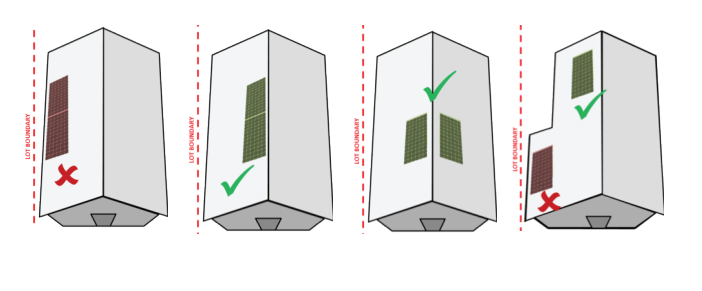
Along with guidelines for new developments, the new solar panel permit application provisions also give recommendations on the appropriate location for solar panels to minimise the overshadowing impact from neighbouring houses. This is to ensure that it is limited and controlled and also mitigates potential overshadowing caused by future adjoining developments. This also gives more accountability to people installing solar panels.
The practice note offers advice for homeowners to improve energy efficiency and minimise the risk of overshadowing when installing solar panels to their properties by locating panels high on the roof line and as far back from the boundary line as possible.
Solar Panel Planning Permit application
If you are submitting a planning application and the neighbouring lot has solar panels you should include the following additional information:
- The location of any existing rooftop solar panels and the extent of any existing overshadowing.
- The extent of the overshadowing of the rooftop solar panels by the new building and works.
- An outline of how the overshadowing of the rooftop solar panels are proposed to be mitigated.
For the new planning requirements to apply the solar panels must exist at the date of the planning application being made.
Solar Panel Council Approval Considerations
When assessing the overshadowing of solar panels in an application the council will look at the following:
- The extent of the overshadowing of the existing rooftop solar panels by existing dwellings or other permanent structures.
- Whether the existing rooftop solar energy panels are appropriately located.
- The effect of the overshadowing on the existing solar panels
If overshadowing does occur, solar panel council approval processes will have to establish whether it causes an unreasonable impact as part of their assessment. Included in such review may be apartment size or building size, and may factor in other considerations such as garden areas or parking numbers.
What is an unreasonable impact?
Factors considered in determining whether the overshadowing impact on existing solar panels is unreasonable or not include:
- The extent of existing overshadowing of the rooftop solar energy facility from existing buildings or permanent structures.
- Whether the new development meets the side and rear setback and north-facing windows standards for residential development under clauses 54 and 55.
- Whether the protection of the existing rooftop solar energy facility will unreasonably constrain or compromise the proposed new development.
- The type of existing rooftop solar energy facility. A multiple string system is less affected by shading than a single string which is more vulnerable to shading, or any other system features such as micro inverters or bypass diodes which can operate with partial shading.
- Whether the siting of the existing rooftop solar energy facility takes into account the potential future development of adjoining lots promoted or permitted under the planning scheme.
- The extent to which the existing rooftop solar energy facility has been located to protect it from overshadowing through placement higher on the roof and further from existing lot boundaries.
Recommendations vs rules
There is no mandatory requirement for solar panel council approval processes to adhere to the rules regarding solar panels set out by the State Government. Councils are still free to make their own assessment of planning applications as they see fit and do not necessarily have to take into consideration the impacts of overshadowing to solar panels. As it stands a planning permit refusal on the grounds of solar panel overshadowing would be extremely unlikely.
In our experience overshadowing of solar panels has never been cited by councils in their assessment of an application. This may be due to councils including it in their assessment of overshading as a whole. The issue is usually only highlighted to council by objectors who have solar panels on their roofs or solar hot water heating systems and are concerned about the impact of a new house being built. It is more commonly addressed at VCAT when a planning permit application has been refused or an objector has appealed a council’s approval of a planning permit.
The new regulations are guidelines to explain best practice when assessing planning applications rather than prescriptive assessment criteria. Although seemingly long overdue they will now help to clarify a previously unclassified area of planning which had no process in place for assessment. It will take time for the amendments to be adopted and applied in the same way as mandatory planning requirements like Rescode. But as solar and renewable energy continue to become more commonly used these provisions will only increase in their relevance and consideration from councils during the planning application process.
This amendment is a positive step by the Victoria State Government. Incorporating these rules into planning regulation ensures that applications are more fairly assessed. It also means that developers will take into further consideration the impact of their project and it gives more assurances to people with solar panels.
Further debate about this planning scheme amendment is likely after the latest version Monash City Council have decided to lodge with the planning minister. With these delays, the future subdivision rules in many areas are still in question.
Monash City Council planning department have announced proposed changes to Amendment C125 which will see more delays to its full approval. Amendment C125 of the Monash City Council Planning Scheme was brought in to implement the Monash Housing Strategy 2014, and included a range of rezoning changes, changes to rear setback limits on properties, and reductions in site coverage restrictions on any block. However, disagreement between Monash Council and the Planning Minister has caused delays with part of the amendment approved and Council advised to revisit and resubmit other aspects of the amendment. An independent planning panel was also engaged and a community consultation process conducted to review the Amendment prior to submission and the panel report outlining recommendations can be viewed here.
The amendment applies new residential zones affecting properties across the City of Monash municipality including parts of Glen Waverley, Clayton, areas near the Damper, Scotchmans and Gardiners Creeks and updates the Local Planning Policy Framework (LPPF) along with inserting a proposed new schedule to the Design and Development Overlay (DDO) and the Development Contributions Plan Overlay (DCPO) to land within the Monash National Employment and Innovation Cluster.
The new residential zones and development standards affecting subdivision rules including rear setback restrictions on any property or block, have been introduced to help protect Monash’s ‘garden city’ character and were originally proposed and submitted to the Planning Minister for approval in 2017. The Planning Minister was critical of certain aspects of the amendment and instead of arrival the whole amendment decided to split it into two parts approving Part 1 and applying recommendations for a future Part 2.
Amendment spilt in two
Part 1 of the amendment approved the proposed Residential Growth Zone (RGZ) and Neighbourhood Residential Zone (NRZ) along with some changes to the Local Planning Policy Framework (LPPF).
The Minister did not approve the following of Part 1:
- Insertion of the schedules to the DDO and the DCPO to block of land within the Monash National Employment and Innovation Cluster.
- Changes to Clause 21.06 as this was recently approved via Amendment C120.
- Changes to Clause 21.15 as the proposed terminology does not align with Plan Melbourne 2017-2050.
- The following changes were also made to Part 1 of the amendment:
- Update of the LPPF to align with 2016 statistics and Plan Melbourne terminology.
- Merging of Clause 21.02 and 21.03 into Clause 21.01 to align with Ministerial Direction — The Form and Content of Planning Schemes.
- Deletion of Schedule 2 to the RGZ as the land is proposed to be rezoned to Schedule 3 of the RGZ.
- Removal of unnecessary objectives from the NRZ and RGZ schedules.
- Inconsequential changes to align the drafting between the schedules and in line with ResCode.
- Removal of ResCode variation for private open space balcony on. A property and rooftop terraces, as this requirement is within the new Better Apartments Design Standards.
- Removal of the requirement for garages on a property to provide an additional 1-metre setback in the NRZ Schedule 1, as ResCode does not allow for such requirement.
- The front setback for a property in RGZ Schedule 3 has been amended to apply 4 metres only, as only one distance can be specified in each schedule.
- Removal of application requirements and decision guidelines that duplicate ResCode and other provisions of the scheme.
- Removal of application requirements and decision guidelines that do not fall within the ambit of discretion of the residential zone schedules.
Part 2 of Amendment C125
The Minister of Planning was unsatisfied with the distribution and application of the General Residential Zone within ‘activity and neighbourhood centres, accessible areas and boulevards’ which includes places near major roads. Therefore, the proposed General Residential Zones were separated into Part 2 of the amendment to be revised and resubmitted at a later date.
The main issue stemmed from Monash’s overly conservative and restrictive zoning of places identified as ‘accessible areas’ and ‘boulevards’, and how this affected housing and subdivision of land. The zoning of these areas and neighbourhoods, as Schedule 2 of the General Residential Zone, restricts higher density development such as apartments.
Despite Monash’s ‘garden city’ character, it was felt that this decision lacked justification and seemed to be in direct conflict with Monash Council’s subdivision rules within their housing strategy which aims to identify appropriate neighbourhoods and locations for residential growth.
Minister of Planning Recommendations
As part of the Planning Minister’s recommendations announced last year; places identified as boulevards and accessible areas should be classed as General Residential Zones (not Schedule Two) or Residential Growth Zones. Any areas Monash wish to restrict to lower density housing should be zoned as Neighbourhood Residential Zones.
In his letter to Monash council the Minister of Planning said:
“I consider Part 2 requires further strategic work on the council’s application of the GRZ. The adopted GRZ features a 9-metre-high discretionary building height control. This approach is no longer possible due to changes to the Victoria Planning Provisions introduced by VC110.
Consequently, the council should review the application of the zone. In locations where the council is trying to maintain lower-scale residential development and character, the NRZ may be more appropriate. In other locations, such as in and around activity and neighbourhood centres, accessible areas and along boulevards where the council’s housing strategy is identifying the need for further growth, a GRZ or even a RGZ may be more appropriate.”
There has been major back and forth from the City of Monash (the ‘garden city’) and the Planning Minister because of this and on February 26 Monash held a meeting and decided to exclude accessible neighbourhoods, areas and boulevards from being included and assessed in Part Two of the amendment.
It has now been proposed that they will be assessed as part of their own separate amendment process. However, it seems the areas now proposed to be included as ‘accessible areas’ and ‘boulevards’ are potentially going to be reduced from what was included in the Monash Housing Strategy 2014.
While awaiting the Minister’s approval, the City of Monash Council are now applying the new zones and development standards. Monash council have advised applicants for new developments to start designing to the new zones and development standards for housing and subdivision.
In the meantime, the areas in dispute will remain zoned as Schedule Two of the General Residential Zone until they are reassessed, and an agreement is reached with the Minister. Which means further delays and that Monash’s amendments will essentially be in effect until a decision is reached.
Timeline of Amendment C125
28 February 2017 Monash Council adopts new residential zones and development standards (including changes to rear setback limits) to bring them into line with the Monash Housing Strategy 2014. The Amendments are submitted to the Planning Minister, Hon Richard Wynne for approval and a community consultation process undertaken.
25 February 2018 the Minister of Planning responds to the Council’s amendment notifying them that the Planning Scheme Amendment C125 would be split into two parts. The minister approved the first part with changes and requested a revision and resubmission of the second part due it
27 March 2018 Council resolves to request the Minister of Planning to approve Amendment C125 Part 2 as originally adopted by Council.
26 February 2019 Monash have now decided to propose that activity and neighbourhood centres, accessible areas and boulevards are not included in Part two of the amendment and assessed separately. They are also set to reduce areas classed as activity centres from what was included in the Monash Housing Strategy 2014.
It appears that the removal of the ‘accessible areas’ and ‘boulevards’ from the amendment was not the preferred outcome from the planning minister. Rather he envisaged that council would retain these and allow for a greater density and diversity of housing types through subdivision to be provided in these areas than would be allowed under Schedule 2 of the GRZ.
However, the City of Monash Council have adopted a different position and simply removed the ‘accessible areas’ from the amendment. This appears to be contrary to the ‘spirit’ of the minister’s feedback so it remains to be seen how the department will respond to council’s proposed part 2 of the amendment.
Very often clients who successfully overturn a council planning application decision want to seek compensation from the other party for costs (legal or otherwise) incurred as a result of a VCAT appeal. This article looks at the circumstances under which such a legal case may be pursued where costs can be awarded for a VCAT planning appeal.
Examples of circumstances where a case may be brought and an order for costs may be made include:
- where a matter was brought to VCAT without much merit
- where a matter was brought to VCAT to harass, annoy or distress someone
- where a matter was brought to VCAT without a serious purpose
- where someone has unreasonably prolonged a hearing
- where someone deceived VCAT or others involved in a case
- where the application made is not well supported, such as by fact or law.
Section 109 of the Victorian Civil and Administrative Act 1998 governs VCAT’s power to award costs. The Act states that each party is to bear their own fees and costs in a VCAT planning appeal, or proceeding or hearing which is designed to promote fairness and to minimise the overall costs in tribunal proceedings. In most town planning appeals, following a VCAT decision, parties will cover their own legal or other costs. However, the tribunal do have the power to award costs to be paid by one party to another if they see fit.
Unnecessary disadvantage
To award costs it must be established there was unnecessary disadvantage caused to a party by the conduct of another party during proceedings and subsequent decision. It does not include the reasonable result of a proceeding that is permitted by a person exercising their review rights under the Planning and Environment Act. For there to be an unnecessary disadvantage and cost awarded to a party the conduct of another party must have gone beyond the normal and reasonable bounds of a proceeding.
Under Section 109 of the Victorian Civil and Administrative Act 1998 the Tribunal may make an order to award costs if satisfied that it is fair to do so, having regard to whether a party has conducted the proceeding in a way that unnecessarily disadvantaged another party to the proceeding by conduct such as—
(a) Whether a party has been responsible for prolonging the time taken to complete the case or proceeding;
- Failing to comply with an order of the Tribunal without excuse;
- Failing to comply with the Act, the regulations, the rules or an enabling enactment;
- Asking for an adjournment as a result of (i) and (ii);
- Causing an adjournment;
- Attempting to deceive another party or the tribunal;
- Vexatiously conducting the proceeding;
(b) Whether a party has been responsible for prolonging the time taken to complete the proceeding;
(c) The relative strengths of the claims made by each if the parties during the case, including whether a party has made a claim that has no tenable basis in fact or law;
(d) The nature and complexity of the proceedings or hearing;
(e) Any other matter the tribunal considers relevant.
If the Tribunal considers that the representative of a party, rather than the party, is responsible for certain conduct during the case such as failure to comply with a Tribunal direction or a VCAT decision, or acts in a way that unnecessarily disadvantages another party, resulting in legal or other costs. The Tribunal may order that the representative in his or her own capacity compensate another party for any fees or costs incurred unnecessarily.
What type of fees or costs can be awarded?
Costs that can be awarded have to be directly incurred due to the proceeding. For building permit, or planning permit or related town planning matters this can include:
- Cost to engage a town planning expert or barrister
- Cost of architect or draft person to amend plans for the appeal
- Cost of an expert witness to appear at the hearing
- Cost in relation to preparing the case
- Cost of travel expenses to attend the proceeding
VCAT cannot award a costs order against a party for costs that are incurred prior to commencing proceedings. Costs can only be awarded from when the application to commence proceedings has been lodged with VCAT and can be awarded at any time. In a VCAT planning appeal, or other VCAT proceding, damages and losses from delaying a development due to a VCAT proceeding or hearing, are not taken into account and will not be awarded.
Typically to commence a VCAT appeal, leave must first be sought from the relevant court that would normally hear such a case which in Victoria would be:
- Court of Appeal (if the decision was from the VCAT President), or;
- Supreme Court of Victoria (if other VCAT members made the decision)
The original VCAT decision lists which party made it.
How much can be awarded?
The Tribunal may order that a party pay all or a specified part of the costs of another party in a proceeding and is at their discretion.
If the Tribunal makes an order for costs, the Tribunal—
(a) may fix the amount of costs itself; or
(b) may order that costs be assessed, settled, taxed or reviewed by the Costs Court.
Can I have cost awarded against me?
If you apply to VCAT to review or appeal a planning decision, then you could potentially end up paying the costs of the other party which may involve costs of building permit or planning permit preparation. However, this is very rare and provided that you conduct yourself correctly during the proceeding such as attending when necessary, not hindering the proceedings and following orders from the tribunal then a cost order will not be issued against you. If you are a building permit or planning permit applicant and are appealing a decision against council, you may have cost awarded to you but again this is very rare. Along with conduct that unnecessary disadvantages a proceeding, costs can also be awarded if council improperly handled your planning application. This can include:
- Not processing an application correctly
- Inaccurately or wrongly issuing a permit
- Withholding consent unreasonably
- Not appropriately considering an application
Objectors to a planning permit
If you have objected or would have been entitled to object to the issuing of a permit you can apply to the tribunal to amend or cancel the permit under Section 89 of the Planning and Environment Act. However, it is important to note, substantial detriment and legal cost can be incurred by the building permit or planning permit holder from defending their permit at VCAT. Therefore, costs when appealing a decision, are more likely to be awarded in these cases.
How do I seek costs from another party?
If you are seeking to be awarded costs against another party, you can make an application to VCAT under Section 109 of the Victorian Civil and Administrative Tribunal Act or Section 150 of the Planning and Environment Act. To make an application you will have to clearly state the amount you are seeking and evidence of how the costs were incurred. You will also have to outline under which Section and Subsection of the Planning Act the proceedings were brought along with the reasons the other party’s conduct caused cost to you.
A planning permit is what is granted to you by your local council following a successful planning application. A planning permit will have conditions attached to it that are contained in the permit. There can be any number of conditions attached to the planning permit but usually there are around 20 – 40 conditions for residential developments.
However a planning permit only forms part of your approval. You will also be required to submit amended plans to council to obtain your full planning approval. This process is commonly known as Condition 1 plans and is part of the planning process for most planning applications in Melbourne and Victoria.
Condition 1 plans on planning permits
Once the planning permit has been issued the permit conditions have to be responded to. This is through amendments to the plans that address the further requirements contained within the permit conditions. The amended plans are then resubmitted to council for approval. Once the council are satisfied the relevant conditions of the permit have been met they will endorse the plans with the council stamp and date. Both the planning permit and endorsed plans then form the full planning approval.
If the condition plans aren’t resubmitted to council then the plans cannot be endorsed and the application will not be approved. The endorsed plans are then used as a basis for the construction and structural drawings that will be used during construction. It is important to note the permit conditions will only require minor changes to the plans. They will not drastically change the development.
Planning permit expiry
Planning permits have an expiry date which is calculated from the planning permits issue date which is stated on the planning permit. There are usually two expiry dates; the date the development needs to have started and the date the development needs to have finished. The permit does not give a specific date but will state for example; work must be started within two years of the permit being issued and finished in four years. If the development is not started and/or finished by these dates then the permit will expire. You can apply to council to extend your permit if you wish. You can extend your permit for 1 – 2 years and council’s in Melbourne and Victoria will usually approve the request if it is the first time the particular permit has been extended.
Planning permit cost
The cost of a planning permit will depend on many factors such as the type of development and the cost of any professionals you engage.
The cost of the planning application fee paid to council to obtain the permit is dependent on the cost of the development and goes up on a sliding scale i.e. the more costly the development the higher the application fee. Most local councils in Melbourne and Victoria have the same standardised fees for each class of application.
Here is an example of some of the residential planning application fees:
Residential Development of One Dwelling ONLY
– $10,000 or less $195.10
– $10,000 to $100,000 $614.10
– $100,001 to $500,000 $1257.20
– $500,001 to $1,000,000 $1358.30
– $1,000,001 to $2,000,000 $1459.50
Development of land including two or more residential dwellings
– value less than $100,000 $1119.90
-100,001 to $1,000,000 $1510.00
– $1,000,001 to $5,000,000 $3330.70
– $5,000,001 to $15,000,000 $8489.40
– $15,000,001 to $50,000,000 $25,034.60
– Greater than $50,000,000 $56,268.30
VicSmart
If the estimated cost is less than $10,000 $195.10
If the estimated cost is greater than $10,000 $419.00
VicSmart application to subdivide or consolidate land $195.10
Please note these are an example of fees and are subject to change. To confirm the correct application fee for your development visit your council’s website or contact their planning department.
How long does it take to get a planning permit in Victoria
The time it takes to obtain a planning permit depends on many factors including;
- The complexity of the development
- The efficiency of the council
- the amount of applications that the council are processing at the time
- if there are any objections to the development
- if there are any planning restrictions or covenants on the site
- inaccuracies in plans or unforeseen town planning issues
Taking these factors into account the average time from the application being lodged to a permit being granted is around six months. The Victoria State Government planning website has a Planning Permit Activity Monthly Report where you can find out the total number of planning application lodged to your council along with the average days it takes them to decide on an application. This will give you can indication of how your council are tracking and how long your application may take. It also provides data on how many application have been approved and refused each month.
Drainage engineering plans
Drainage engineering plans must be submitted to council for approval in order for you to obtain a building permit to start construction of your development. Council’s like Knox and Banyule require drainage engineering plans to be completed before they endorse development plans and issue the planning approval.
However most council’s do not require this and the drainage engineering plans can be completed and submitted to council after the planning approval has been issued.
It is important to find out whether or not your local council needs drainage engineering plans submitted before or after planning approval. Not knowing can cause delays in your application as you may not have organised the plans to be produced at the right time.
VicSmart is a process for fast tracking simple planning applications for smaller developments. This article outlines how a proposal may qualify as a VicSmart application and also describes the difference between a full planning application and a VicSmart simpler planning permit process.
There are two tiers of planning applications in Victoria, a full development application and a VicSmart simpler planning permit application. VicSmart was bought in to simplify and streamline the planning permit process for straightforward planning applications and since indroduction has had subsequent amendments VC135, VC137, VC142 and others. VicSmart is available for planning applications in Melbourne and all throughout Victoria.
VicSmart planning applications are assessed through pre-set decision guidelines that are set out in the VicSmart planning provisions for the class of application.
Key features of VicSmart
- 10 business day fast track planning permit process
- Applications are not advertised to the public
- Pre-set required information to be submitted with a VicSmart planning application
- The Chief Executive Officer of the council or delegate decides the application.
Town planning consultants in Melbourne and wider Victoria are more likely to be engaged for full planning applications rather than VicSmart due to their simplicity.
VicSmart fast track applications are appropriate for small scale developments or building works:
- Tree lopping and removal
- Minor subdivisions
- Car park loading bay waivers
- Small advertising signs
- Small scale or low impact buildings and works
VicSmart town planning application process
- Talk to the local council and confirm whether you are eligible for VicSmart
- Submit your application with all the require information. You can find the VicSmart Checklist of what is required here and more information at The Complete VicSmart Guide website here.
- A council officer assesses the application through pre-set decision guidelines
- The application is decided and either approved or refused within 10 business days
The 10 business days starts from the day after council’s receipt of the application. It is possible to amend a VicSmart town planning application. The 10 days will start again from the day the amendment was received.
If required information has not been supplied, further information will be requested in writing from council. If the request for further information is made within five business days of receiving the application, the council will have a further 10 days to decide the application from when the request has been responded to.
You have the same review rights as with a full development town planning application and can apply for an application for review for the following:
- failure to grant a permit within the prescribed time – 10 business days
- refusal to grant a permit
- conditions in a permit
- refusal to extend the time to commence or complete a development or use.
The full development application town planning process
- The town planning application is lodged with the council and assigned to a town planner. Within 28 days of being assigned the town planner may write to request further information or request to amend aspects of the design that they would like to see changed. This happens in most planning applications
- The town planning application is advertised for a minimum of 14 days. A sign is usually erected on the site for the duration which outlines what the development application is for. Council also notifies the neighbours and gives them the opportunity to object.
- The council assess the application against the planning scheme, taking into account any objections and comments from referral authorities like Vicroads and negotiating with the permit applicant regarding any changes the town planner would like.
- The council will issue their decision which will either be a planning permit, a notice of decision or a refusal.
- Depending on the area where the application is made (for example in a heritage precinct), considerations of heritage studies or overlays may be applicable
If there have been objections to the development, then the council will issue a notice of decision to grant a permit. This gives objectors 28 days to apply to VCAT if they wish. If no application to VCAT is made, then the permit will be sent to you after the 28 days.
If the council refuse the application or if you are unhappy with some of the condition of the permit you have 60 days to appeal the decision at VCAT.
VicSmart Process Advantages
- VicSmart planning assessment takes 10 business days from the application being lodged to a decision being reached.
- The council application fee is less than for a full planning application
- The VicSmart application is not advertised to the public with the possibly of objections
VicSmart Disadvantages
- Only certain applications qualify for VicSmart
- All information has to be prepared prior to lodgement including comments from referral authorities if required
- It may take longer than 10 days due to information not supplied, inaccurate information, design negotiations or another outstanding matter
Town Planning applications Fees
Vicsmart application fees are a lot lower than the fees for regular planning applications. Councils will charge either $195.10 or $419.10 for a VicSmart application depending on what it is for. These fees are applicable for all local councils in Melbourne and throughout Victoria.
A full list of the fees are below:
VicSmart application if the estimated cost of development is $10,000 or less
$195.10
VicSmart application if the estimated cost of development is more than $10,000
$419.10
VicSmart application to subdivide or consolidate land
$195.10