

It is well known that architects and town planners have a symbiotic relationship and sometimes adversarial situations arise when planners are overly conservative in accepting innovative design solutions. The town planning process can often be an arduous experience for architects and their clients who get frustrated at town planners subjective assessment and their perceived ‘making up of the rules’. It is common for architects to have to make unreasonable compromises in their design response purely in the interests of achieving the necessary town planning approval. Town planners have an exceptionally high level of influence over the design response of new buildings and this can be inappropriately exercised at times. The added costs associated with redesign work together with the required compromises and delay in commencing the project construction can cause stress for clients and their architects.
A lot of these frustrations can be avoided if a town planner is engaged to guide the design response of the architect from inception. A more proactive approach can save time, stress and the costs associated with reactive design amendments after the town planning application has been lodged. The benefits of collaborating with a town planner from project inception are:
1. Increased certainty of approval.
Architects and building designers are excellent at creative design and innovation to meet their clients brief. However, an innovative and excellent design does not guarantee planning approval. A professional town planner can consult with the architects from a town planning approval perspective so that the design strikes the effective balance between innovation and an acceptable town planning outcome. This guarantees the planning approval for the proposal will be granted.
2. Time savings.
Professional advice about the town planning parameters are site and proposal specific and clarifying these from the outset establish an ‘envelope’ for an architect and a client to work within. This advice can relate to perspective requirements like building heights, setbacks and the like but can also be descriptive in nature related to elements like selection of finishes based on established neighbourhood character. This helps ensure the project is designed in a proactive approach to meeting town planning requirements which avoids the timely process of redesign work.
3. Reduced amount of design compromises post application lodgement.
Almost all clients and architects accept that an assessing council planner will request some further information and possibly compromises in their proposal before approving the planning permit. By engaging a professional planner to assist in the application preparation these requests can be mitigated resulting in less redesign work and minimal compromises post lodgement.
4. Reduced stress for clients.
Clients can become ‘wedded’ to a design and when this happens they can be reluctant to make compromises in the interests of obtaining the required planning approval. This can be a stressful and upsetting experience for clients that can be avoided with a proactive approach.
5. Let architects be architects.
Architects take on a holistic role in projects and can find themselves wearing many hats. This includes being the listed council contact to obtain the necessary town planning approval. This is a role that is often beyond their expertise and takes up a lot of their time. A professional town planner can reduce their workload and allow them to focus their skills on what they do best.
There are differing opinions as to whether a town planner or an architect should be engaged first on a project. We are of a view it is best to appoint them in tandem or appoint a town planner first to set the planning context for the architect and the client to work within. Here at CS we provide our clients a memorandum of advice at the outset of projects that creates certainty around the planning requirements and assists architects defining the project parameters that minimises the level of redesign work required post application lodgement.
Public notice, also referred to as ‘advertising’ of an application is a standard step of the council application process where the local council give notice of your application to the public.
How is notice given?
A direct mail out to abutting landowners is the most common way council give notice of an application. A letter in the mail addressed to the registered proprietor of a site and the occupier is sent via Auspost and this one page letter contains information about the application. The information provided includes:
- A description of what is being applied for;
- How the plans can be viewed;
- How any submissions or objections can be made;
- The closing date for submissions to be received by Council.
Council have discretion to choose which abutting owners will receive a direct letter. Typically those properties that share a boundary with the development site and those directly opposite the site will receive a letter directly from Council.
In addition to a mail out, council will ordinarily require a poster to be erected on the subject site for 14 days to notify the general public about the application. A poster will ordinarily be up to A3 in size and contain the following information:
- A description of what is being applied for;
- The name of the applicant;
- How the plans can be viewed;
- The closing date for submissions to be received by Council.
What happens during the notice period?
This period allows members of the public or abutting land owners to make submissions to council about how the proposal may affect them. Typically these are known as objections but submissions of support can also be made by members of the public. Landowners who receive a direct mail notification about the application are not obliged to respond if they do not wish to do so.
How long does the period last?
Public advertising will typically last 14 days, this period is extended at Christmas time to reflect the fact most people are on holidays during this period and away from home.
How do Council treat planning objections?
Objections are common for planning applications and Council is obliged to consider the submissions before issuing a decision on an application. For an objection to be seriously entertained by Council there must be some demonstrable material detriment to the objector by the grant of the permit. Planning objections that are from an ‘in principal’, ‘Not in my backyard’ perspective are given very little weight in the assessment of an application.
Do the number of objections influence the outcome?
The number of objections should not influence the planning assessment of the proposal under the planning and environment act 1987 and the local council planning scheme. From a political perspective it is common for particularly contentions applications to attract a ground swell of local resident opposition and this can lead to the politicisation of the town planning process.
Can late objections be considered?
Typically council will consider any objections lodged up until the date they issue a decision. This applies even if the closing date of the notice period has passed.
How can I avoid objections?
Objections to town planning applications is common and sometimes it is too difficult to establish a middle ground between parties. We encourage you to discuss your plans with your neighbours before you lodge an application. You might not reach agreement with your neighbours, but engaging with them in a proactive way can avoid the objection escalating to a VCAT appeal after the council issue their decision. If you have received objections to your proposal our skilled advocates can undertake mediation on your behalf and seek to resolve the issues before they result in an unfavourable result.
Minimum standards in relation to apartment sizes, daylight and ventilation are likely based on a final report handed down by a standing committee of the state government. The committee has recommended that the Victorian Government review if the ‘Better Apartments Design Standards’ first introduced in 2017 are fit for purpose.
Background
In 2017 the State Government introduced design guidelines into the state-wide Victorian Planning provisions aimed at introducing minimum design objectives to achieve liveable apartments throughout the state. As apartments grow in popularity there is growing pressure to introduce a more robust framework for designing and assessing the layout of this housing type. Some popular measures being explored are minimum mandatory apartment sizes and access to daylight. The committee found that while some prescription, including minimum apartment size, can lead to improved outcomes, a mostly performance-based approach should be used to ensure design does not become a tick the box exercise.
The findings
The report compared the Victorian system to other states and encouraged the adaptation of some measures used by the NSW and South Australia government. South Australia has a design review framework with a separate Local Design Review Scheme which provides local councils a consistent state wide approach to design review. The report recommends mandating a greater diversity of residential unit sizes, including larger apartments for families. It also says there should be minimum room sizes for kitchens and dining areas, along with adequate storage space. You can read the full list of recommendations and report here, the most notable recommendations and findings were:
- Provide a minimum size for new apartments in its next review of the BADS.
- Define and quantify ‘adequate daylight’, incorporating considerations around sunlight.
- Specific metrics for assessing building setbacks
- Improved environmental sustainability measures including future proofing buildings for electric cars and the like.
- Explore the establishment of the potential for a state-wide panel of experts to guide and assist local councils in assessing proposals.
Next Steps
The Victorian government has six months to respond to the report and given the state election is set down for November 2022, there is unlikely to be any changes to the current planning provisions until after the election.
The findings of the report were consistent with our own anecdotal experiences in applying the guidelines as they exist today. We expect there will be a heightened imperative on sustainability measures as technology evolves but we are also acutely aware that innovation moves much quicker than legislative change so we feel it will be up to industry professionals to ‘lead the charge’ rather than react to legislative reform in this realm.
VCAT has introduced a new process for fast tracking certain types of town planning appeals. Applications that can be made under the new fast track process are refined to simpler matters where the tribunal can make a prompt decision. The following applications will be automatically added to the fast track list from the 1st July 2022:
- Applications to extend the lapse date of a planning permit;
- Amendments to existing permits;
- Section 149 matters that are ‘to the satisfaction of the Responsible Authority’
- Section 184 applications to end or amend agreements
- Refusal to issue a certificate of compliance.
Applications made in any of these categories will aim to be heard within nine weeks of the appeal being lodged. If a practice day is required for the appeal then the timeframe will stretch out to twelve weeks. Oral decisions will normally be issued, on the day at the conclusion of the hearing. If the tribunal reserve a decision then parties can expect a decision within two weeks after the hearing for less complex matters. Applicants can request their appeal not be added to the fast track list if they wish the matter to be heard on the standard list and any application being considered under the fast track list cannot be amended by the applicant. The same statutory application fees apply whether the case is added to the fast track list or considered under the normal list. Click here for a VCAT issued fact sheet on the fast track list.
In April 2022, the Supreme Court issued a precedent setting decision that reversed the commonly held statutory planning principal that an amendment to a statutory town planning permit should not lead to a transformation of the proposal. Previously, where an amendment constitutes a ‘transformative change’ then a fresh application needed to be made for the proposal.
The Decision
In the recent case of Mondib Group Pty Ltd V Moonee Valley Council the permit applicant sought a review by the court of a decision issued by the tribunal to refuse an amendment application on the basis that the amendment constituted a transformation of the original approval. The court found that the ‘transformation test’ was no longer applicable to amendment applications on the basis that an amendment application goes through the same statutory assessment process as would be applied to a new application. Critically, the court found that because amendment applications are advertised to the public they are subject to the same level of scrutiny as normal applications. On that basis there was no reason for the transformation test to be applied and the scope of what can be considered under an amendment becomes much broader.
Implications
This decision has far reaching implications for planning permit holders. The favourable implications are that it will allow permit holders to make amendment applications and not be concerned about the qualification of the changes to be considered as an amendment. There is also the benefit of likely reduced fees and a more refined assessment that comes with a permit amendment application in lieu of a fresh application for a permit. The decision does beg the question ‘Can a live permit be amended indefinitely?’ The removal of the transformation test does allow for development to now be considered for approval under the guise of an amendment to a historic planning permit. There is a very real issue of this, particularly for historic developments that would not nowadays receive a permit under the modern version of the planning scheme. Akin to most precedent setting decisions, it has benefits and negatives depending on your permit situation and perspective. The vast majority of permit holders will benefit from the decision but for decision makers, referral authorities and third party objectors there is more planning ambiguity arising from the decision.
In January 2022 the state government introduced a new statewide ‘Transport Zone’ to planning schemes which you can read about here.
Following this, on the 17th February 2022, the government introduced a new statewide planning provision. Clause 53.21 introduces exemptions for transport projects from planning permit requirements. The provision is specific to applications made by Transport Victoria and replaces councils as the decision maker with the Minister for Planning. The amendment was prepared by the Minister for Planning and also removes any third party appeal rights and public notification requirements for the applications.
The purpose of the amendment is clearly to fast track planning approval for essential state infrastructure projects earmarked by Transport Victoria to be built. Infrastructure development has been a mainstay of both the Labour and Liberal governments in recent years in Victoria and given 2022 is an election year, this amendment is expected to lead to the announcement of more major road and rail projects in the lead up to the election.
On the 20th January 2022 the minister for planning introduced a new Transport Zone state wide to planning schemes.
The new zone replaces the former Road Zone Categories 1 and 2 that were defined at clause 52.29 of the scheme. The new road zones are:

The new TRZ1 zone replaces the Public Use Zone (4) within the planning scheme to identify land used for state transport infrastructure and other major sections of infrastructure. Former Category 1 road zones become TRZ2 and Category 2 road zones become TRZ3. Clause 52.06 – 9 of the planning schemes has been updated to reference requirements for access ways and car parks to access roads in the transport zone 2 or 3. The most notable change is that the access to car parking spaces must be at least six metres from the road carriageway in either of these two zones.
The reason for the amendment was to make the planning schemes more concise and transparent in relation to roads and other infrastructure and to allow a more coordinated government response to infrastructure upgrades across the state. The minister claims that ‘consistent zoning for transport land will directly support the approval and delivery of a wider range of transport projects including Victoria’s Big Build.’
We concur that the replacement of the ‘Public Use Zone 4’ with a ‘Transport Zone 1’ is a more transparent measure to identify state significant infrastructure. The amendment also sees the Department of Transport replace VicRoads as the referral authority for planning permit applications.
Overall the amendment is largely a change to the name of the zones rather than any requirements within the zones. The requirements for car parks, access ways and crossovers largely remain the same and there is very little consequence of the change of zone on new or current applications.
The Victoria Budget for 2021-2022 was released in May 2021, introducing a number of new measures that will soon be voted on by the Victorian Parliament. A number of measures are directly targeted at the Victorian property sector including both tax increases and concessions.
The major changes include land tax increase by 0.25 per cent for taxable land holdings between $1.8 million and $3 million, and 0.30 per cent for taxable land holdings in excess of $3 million; a new rezoning tax where windfalls above $500,000 would be taxed at 50 per cent, with the tax phasing in from $100,000 and a premium stamp duty for property transactions above $2 million, attracting a $110,000 duty plus 6.5 per cent of the dutiable value in excess of $2 million.
Measures in relation to the property sector announced in the Budget are listed below, along with their expected start date:
Rezoning Tax
New windfall gains tax of up to 50% to be applied to planning decisions to rezone land. The total value uplift from a rezoning decision will be taxed at 50% for windfalls above $500,000, with the tax phasing in from $100,000.
Starting from 1 July 2022.
Stamp Duty
New premium land transfer duty (stamp duty) rate for property transactions with a value above $2 million, increasing stamp duty payable to $110,000 plus 6.5% of the dutiable value in excess of $2 million.
Applies to contracts entered into on or after 1 July 2021.
Land Tax
The land tax rates for high value landholdings will increase for taxable landholdings exceeding $1.8 million by 0.25 percentage points, and for taxable landholdings exceeding $3 million by 0.30 percentage points.
2022 land tax year
Victorian Treasurer Tim Pallas said during the budget announcement, $2.7 billion would be raised by a suite of measures and the “modest” increase would only affect a fraction of the 10 per cent of Victorians who pay land tax, which is not paid on owner-occupied homes. Mr Pallas said the rezoning tax is a move that would claw back around $40 million a year from developers and speculators who made huge profits after a local council’s “stroke of a pen” to rezone industrial land for residential use. According to the state government, the measure is aimed at balancing home buyers wanting to purchase a home and property investors who continue to profit from increasing property values.
Other than the headline tax hikes, the budget also announced other measures aimed at encouraging population into Melbourne CBD apartments:
Stamp Duty Concession within the City of Melbourne
Temporary land transfer duty (stamp duty) concessions for new residential property within the City of Melbourne local government area with a dutiable value up to $1 million. A 50% concession will be available for new residential properties. A full exemption will be available for new residential properties that have remained unsold for 12 months or more since completion of construction.
Concession applies to contracts entered into on or after 1 July 2021 and on or before 30 June 2022
Exemption applies to contracts entered into on or after 21 May 2021 and on or before 30 June 2022
Off-the-Plan Duty Concession
Temporary increase in the eligibility threshold for the off-the-plan duty concession to $1 million for all home buyers.
Applies to contracts entered into on or after 1 July 2021 and on or before 30 June 2023
Victorian Treasurer Tim Pallas said “It’s only fair that those making large profits return a reasonable proportion to the community – this means more Victorians can have the schools, hospitals and support they need and deserve. Our tax system is fair and progressive – making sure that everyone pays their fair share to support Victoria’s economic recovery.”
Sending a Message
The Budget will also revoke land tax concessions for private gender-exclusive clubs such as the Melbourne Club, which has all-male membership. The land tax concessions were intended for not-for-profit societies, rather than “increasingly anachronistic” elite clubs.
“We’re not saying that they’re illegal, we’re simply saying you shouldn’t get the gift of the taxpayer to conduct these bodies and certainly from our point of view the idea of male-only clubs, their time is well and truly passing,” Victorian Treasurer Tim Pallas said. The state government does not expect large savings made in that move, it was more about sending a message to the community.
Private Partnership to Boost Public Housing
The Victoria State Budget 2021-2022 also announced measures that are not tax related. A private-public partnership will create hundreds of social housing units as part of its $5.3 billion public housing build with 1,110 new homes to be built on government-owned land in Brighton, Flemington and Prahran.
The homes will be a mix of 619 social housing dwellings, 126 affordable homes and 365 market rental homes, including 52 specialist disability accommodation dwellings. Under the plan, the government will put in $50 million while a private consortium will provide $465 million upfront to construct the homes. The consortium will have a lease on the sites for 40 years, collecting income from the rent and maintaining the properties while the state government repays the $465 million to the consortium during that 40-year period.
Planning Minister, Richard Wynne, said after that time, all the property and homes would return to government hands to become social housing and “full consultation” with local communities on the design will take place and he hoped to have construction underway before the end of the year.
As part of a planning application process, we often see a condition within the planning permit that requires the permit applicant to enter into a Section 173 Agreement with the responsible authority, being the council in most cases. So what is a Section 173 Agreement and what are the obligations involved?
During the planning application process, the responsible authority (council) can negotiate an agreement with an owner of land to set out conditions or restrictions on the use or development of the land, or to achieve other planning objectives in relation to the land. These agreements are commonly known as section 173 agreements. The power to enter into the agreement arises under section 173 of the Planning and Environment Act 1987 (the Act).
The Act provides that a section 173 agreement can be entered into between a responsible authority and an owner of land (normally the registered proprietor). Provided the responsible authority and owner are parties to a section 173 agreement, other persons or bodies may be additional parties to the agreement and become bound by the terms of the agreement. This may include, for example:
- A planning authority or referral authority where it is useful for that body to coordinate its powers or functions in relation to the land.
Like other agreements, a section 173 agreement is a legal contract. However, a section 173 agreement can be recorded on the title to the land so that the owner’s obligations under the agreement bind future owners and occupiers of the land. A section 173 agreement can also be enforced in the same way as a permit condition or planning scheme.
Councils use a Section 173 Agreement as leverage to ensure the permit applicant and those who owns the land after will adhere to the conditions or restrictions by including the preparation of Section 173 Agreement as a condition in the planning permit. The purpose of an agreement is to achieve planning objectives for an area or particular parcel of land than is not possible when relying on other statutory mechanisms.
What can an agreement cover?
Unlike a planning scheme provision or permit condition, which allows something to be done, a section 173 agreement can expressly require something to be done. This is particularly useful where a responsible authority wants to guarantee certain outcomes prior to, or as part of, the granting of a planning permit for a specific use or development. The Act allows the section 173 agreement to provide for:
- The prohibition, restriction or regulation of the use or development of land.
- Conditions subject to which the land may be used or developed for specified purposes.
- Any matter intended to achieve or advance the objectives for planning in Victoria under the planning scheme or an amendment.
This provides a wide scope for agreements. However, there should generally be a connection between the agreement and the specific planning outcomes sought to be achieved in relation to the land over which the agreement will be recorded. Section 173 agreements have been used in a wide variety of matters. Some examples are:
- Coordination of development with adjoining landowners or other regulatory authorities.
- To provide for staged developments.
- Rehabilitation of property, repair of the environment, heritage protection or vegetation protection.
- Provision of community infrastructure or specific development infrastructure – such as open space or facilities on the land or nearby land.
- Securing developer contributions.
- Restrictions on change of use, or abandoning existing use rights.
- Limits on future development, including neighbourhood agreements to protect neighbourhood character
- Planning ‘trade-offs’, such as a planning concession on one property based on a commitment to do something on another property.
Example of a Section 173 Agreement:
CS Town Planning has been engaged by Simond’s Homes as part of their collaboration with Department of Health and Human Services to build social housing around Victoria. Our team of experts are involved in obtaining planning permits for the program from different councils within Victoria, such as Greater Geelong Council, Bendigo Council, Monash City Council and many other councils. In many of the permits successfully obtained, a condition involved the land owner of the property (DHHS) to enter into a Section 173 Agreement with the Responsible Authority (Council). Using a project in Norlane, we provide an example on how Section 173 Agreement is utilised by Greater Geelong Council to ensure their objective is achieved.
Greater Geelong Council has a long history of land owners connecting the stormwater pipes to points other than the legal point of discharge, causing floods and complaints by residents. This may be caused by sloped topography of a lot of the land or short cuts taken during the development of the dwellings. Greater Geelong Council wants to ensure all new dwellings are connected to the legal point of discharge correctly and well maintained moving forward. Hence the condition within the permit requiring the land owner (DHHS) to enter into a Section 173 Agreement. The condition of the permit reads:
Unless otherwise approved by the Responsible Authority and prior to the Commencement of the Development, the landowner must enter an agreement with the Responsible Authority pursuant to Section 173 of the Planning and Environment Act 1987. All costs associated with setting up the agreement must be borne by the landowner. The agreement is to be registered on title and run with the land, and is to provide to the satisfaction of the Responsible Authority:
- All storm water runoff is to be collected on site and discharged to the legal point of discharge using a pump system or as otherwise nominated by the responsible authority. The pump system is to be designed and constructed in accordance with Australian Standard 3500 Part 3.2 Section 9
In order to meet this condition of the permit, a Section 173 agreement is required to be prepared by the land owner’s solicitor. Once the draft Section 173 agreement is prepared, the solicitor who represents the council will than review and advice any amendment required.
Depending on the purpose of the Section 173 agreement, the terms in the agreement are tailored to meet the purpose and the condition of the permit. In the Norlane example, the Section 173 agreement has clauses that list out the ‘Specific Obligations of the Owner’:
- Stormwater runoff is to be collected on site and discharged to a legal point of discharge using a Pump System, or as otherwise directed by the Responsible Authority.
- In the event of any operational difficulties with the Pump System installed on the Land pursuant to the Permit, the Owner must promptly and at its cost rectify those difficulties to the satisfaction of the Responsible Authority.
Other than the specific obligation, the Section 173 agreement also specify that the Land Owner:
- Will not sell, transfer, dispose of, assign, mortgage or otherwise part with possession of the Land or any part of it without first providing to its successors a copy of this Agreement.
The purpose of this clause is to ensure the section 173 agreement also applies to future owners and occupiers of the land.
After the draft Section 173 agreement is approved by council, both the council and the land owner will execute the Section 173 agreement. Once the Section 173 agreement is executed by both parties, the Section 173 agreement is then lodged to Titles Office and officially registered on the title. The condition in the planning permit is now met.
The Section 173 Agreement in the Norlane example is just one of many Section 173 agreement examples. Meeting a Section 173 Agreement planning permit condition can be difficult, if you have any questions about the process, feel free to contact the team at CS Town Planning who will be able to assist.
Recently, City of Stonnington started to exhibit planning scheme amendment – C296ston which seeks to introduce a Development Contribution Plan (DCP) to the Stonnington Planning Scheme. The amendment will require all land owners who are seeking to utilise their property’s development potential to provide a monetary contribution to infrastructure upgrades and community facilities like roads, footpaths, drainage and community facilities such as an Aquatic Centre upgrade.
A Development Contribution Plan (DCP) is often used in regional urban growth areas where basic infrastructure are lacking, such as City of Wyndham or City of Casey, as a mechanism to levy contributions from new developments to go towards the provision of planned infrastructure required to accommodate the needs of a growing population.
In accordance with the Planning and Environment Act 1987, the State Government’s Development Contributions Guidelines 2007 and associated Ministerial Directions, the types of projects that are able to be funded through a DCP must be ‘capital works’, which can be defined as:
- A new item of infrastructure (i.e. a new childcare facility);
- An upgrade to the standard of provision of an existing infrastructure asset or facility (i.e. improvements to a kindergarten to provide for 3 year old sessions);
- An extension to an existing asset or facility (i.e. adding female change rooms to a pavilion); or
- And the replacement of an infrastructure item after it has reached the end of its economic life (i.e. reconstruction of a road).
And the types of infrastructure projects that may be included within a DCP must be either:
- Basic to health, safety or wellbeing of the community,
- Or consistent with the community expectations of what is required to meet its, safety or well being,
- Roads, paths, drainage, open space improvements and community facilities.
City of Stonnington are proposing this amendment because the city is experiencing significant residential, retail and commercial growth and the council believes the growth will have an impact on the city’s infrastructure, placing financial burden on the Stonnington community. The proposed Development Contribution Plan aims to ensure that developers make a fair contribution to the community and offset part of the cost of the planned infrastructure work. The research data provided by the City of Stonnington identifies an extensive list of infrastructure projects based on the city’s 10 Year Capital Works Program 2020/2021 that would be eligible to be funded under a Development Contribution Plan program. The proposed Development Contribution Plan does not replace the Open Space Levy, both contributions will be charged concurrently, further increasing the development costs.
According to City of Stonnington, the council have identified 197 projects within the municipality which qualify for a DCP and the amendment will allow the council to collect approximately $49.5 million of the estimated total cost of these projects (total cost is approximately $259 million). The full list of projects can be viewed in the council’s Municipal Wide Development Contribution Plan 2020 incorporated document.
What developments would make a contribution under the DCP?
If the amendment is approved and gazetted, all new development proposing to increase the number of dwellings and/or increase leasable commercial, retail or industrial floor space will be required to make a proportionate contribution.
Meaning even minor developments such as a two lot residential subdivision, extension to a shop or a new mezzanine level within a warehouse will be required to pay the Development Contribution levy under the new amendment.
How much would a new development be levied?
The amount levied to a new development is calculated based on the developments’ projected ‘share of usage’ of the planned infrastructure. The cost of an infrastructure project is apportioned to all demand units (existing development, external demands and new development). The estimated share of cost attributed to new development is approximately 19 percent of the cost of infrastructure.
The City has been divided into nine analysis areas/charging areas, based on suburb boundaries:
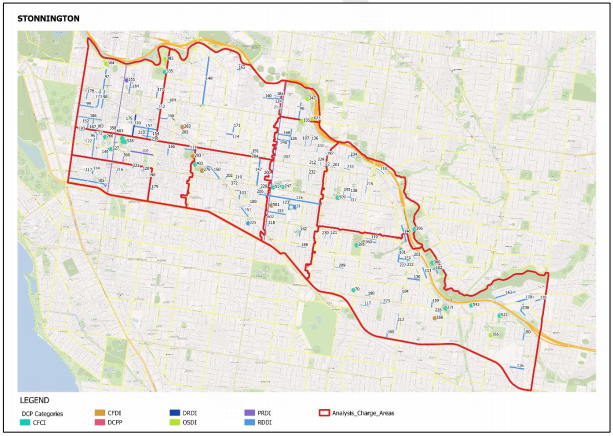
A demand unit is than calculated based on the development type and used as a measure in the calculation of a development contribution. To calculate a common demand unit across development types (residential, commercial, retail, industry) an equivalence ratio is used to convert the amount of existing and projected development for each type, into a proportional number of common demand units. Similar to adding together different currencies, where a formula is used to convert them into the same currency.
In the case of a demand unit, existing and proposed dwelling numbers and commercial/ industrial/retail floor space are converted into the same measure. These ratios differ depending on the nature of the infrastructure category (drainage, public realm, road, open space, community facilities) as illustrated in the table following:
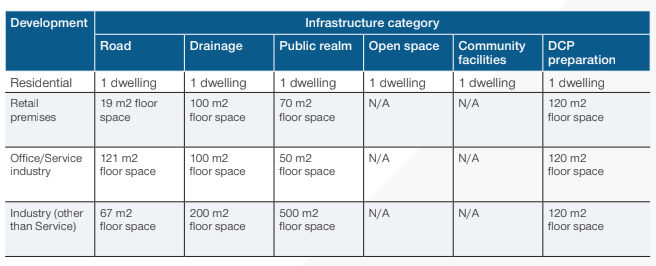
Using residential developments as an example, the charges payable per new dwelling are as following:

Using a two lot subdivision development in Malvern as an example, the Development Contribution levy payable is estimated to be as follow:
- $1,210.00 of Community Infrastructure Levy
- $1,995.15 of Development Infrastructure levy (Residential)
- Total Levies payable – $3,205.15 per new dwelling.
If a retail shop owner in South Yarra is proposing to do a 500 sqm extension to the existing retail shop, the estimated Development Contribution Levy payable is calculated as follow:
- $0 Development Infrastructure Levy (Residential)
- $13,560.00 Development Infrastructure levy (retail or commercial or industrial)
- Total Levies payable – $13,560.00
If a developer is seeking to do a 20 dwelling residential development with 600 sqm of retail space in Armadale, the Development Contribution levy payable is estimated to be as follow:
- $24,000.00 of Community Infrastructure Levy
- $39,179.60 of Development Infrastructure Levy (Residential)
- $24,054.00 of Development Infrastructure Levy (retail or commercial or industrial
- Total Levies payable – $87,433.60
Please note the calculations provided by City of Stonnington at this time are estimations only. The calculated contribution amounts are current as of 1 August 2020. They will be adjusted annually on 1 August each year to cover the cost of inflation and fluctuations in the cost of construction. The council has developed an estimation calculator and published on the Council’s engagement platform.
Are there transitional provisions for payment of levies and when does the DCP need to need to be paid?
There are no transitional provisions for the Amendment C296ston. If Amendment C296ston is approved, levies will need to be paid from the time the amendment is gazetted.
When you lodge your planning or building application, Council will provide you with an indication of the amount that you will need to pay. Confirmation of the exact amount will be provided when the planning or subdivision permit is issued or when a building surveyor is appointed.
Payment of the Development Infrastructure levy must be made at one of the following stages:
Payment of the Community Infrastructure Levy must be made before a date of issue of a Building Permit.
- Before a Statement of Compliance for a subdivision is issued
- Prior to commencement of works
- Before a building permit is issued
What happens if I have been issued a planning permit?
If a planning permit has been issued before the approval of the DCP, the levy will not be required to be paid. However, this does not mean the Development Contribution Levy is not required to be paid. Under the proposed amendment, the contribution will be payable if you require a building permit and it is issued after the approval of the DCP. If you amend your planning or building permit after the Development Contribution Plan is approved and gazetted, you may still be required to pay a levy or levies.
The majority of land owners will not start the build immediately after the planning permit is approved and often wait for one or two years before applying for a building permit. If the amendment is approved after your planning permit was issued but before your building permit is issued, the Development Contribution Levy will still be required to be paid.
Another trigger for the Development Contribution Levy is when a land owner applies for a subdivision permit and it is issued after the DCP has been incorporated into the Stonnington Planning Scheme.
The proposed amendment is currently on exhibition from 25 February to 31 March 2021 and is available for inspection at Stonnington City Council or online at the Department of Environment, Land, Water and Planning website at this link.
The City of Stonnington Council is also hosting two online information sessions:
Session 1 – Tuesday 16 March, 6pm to 7pm, click here to register on councils website.
Session 2 – Thursday 18 March, 12pm to 1pm, click here to register on councils website.
Any person who may be affected by the Amendment may make a submission to the planning authority. Submissions about the Amendment must be received by City of Stonnington by 31 March 2021.
A Panel Hearing for the proposed amendment is schedule to commence on the 2 of August 2021. Depending on the result of the Panel Hearing, the proposed Amendment may either require the council to make adjustments to the amendment, similar to the outcome of Monash Council proposed Amendment C148, or proceed to seek approval from the Minister of Planning. If you would like to read about Monash’ proposed Amendment C148, click here.
If you are directly impacted by the proposed development contributions proposed by Council and would like to know how much you may have to pay council please give us a call to discuss your case.