

The assessment of ‘neighbourhood character’ has been a long standing contentious issue in the assessment of planning applications. Recognising that this tension shows no sign of abating the state government recently released Planning practice notes PPN90 and PPN91 with the aim of guiding local council planning departments on best practice in how to prepare their planning schemes to accommodate housing growth in some areas, balanced with the protection of neighbourhood character in others.
Local council’s housing strategy is often accompanied by a neighbourhood character strategy along with other relevant strategic work such as heritage, landscape, environmental or land capability studies.
While a housing strategy identifies the extent and density of future housing, a neighbourhood character strategy assists in identifying valued characteristics of areas that need to be considered when identifying the preferred future character for residential areas. Actions can then be identified to ensure that existing character is respected, or a preferred new character is achieved. Conflict arises however when the housing strategy identifies a need for housing growth in a specific geographical area and the neighbourhood character strategy places an emphasis on retaining features such as ‘spaciousness’ and ‘large gardens’ in the same geographical area. The practice notes aim to resolve this inherit conflict that is created when these conflicting objectives make their way into planning schemes.
Role of local housing strategy:
- Ensures a range of housing opportunities are available across the municipality to meet the needs of the projected population
- Outlines the strategies and implementation mechanisms to accommodate the projected population and household needs
- Identifies where and how the housing needs of the future population will be met across the municipality
- Identifies suitable locations for housing growth including those areas close to services, jobs, public transport and activity centres, and strategic development areas.
Role of local neighbourhood character strategy:
- Considers both the public and private realms
- Provides strategic direction for neighbourhood character to guide future development through preferred neighbourhood character statements or neighbourhood character objectives
- Identifies the comparative significance of each neighbourhood character area. In assessing the significance of areas, comparisons need to be made, not only with other parts of the municipality but also with the wider region
- Forms the basis for neighbourhood character statements, policies, objectives and local variations to clause 54 and clause 55 being included in residential zone schedules, a Neighbourhood Character Overlay or other overlay.
Neighbourhood character is not a static concept, streets and neighbourhoods are dynamic places and evolve over time to meet modern living standards and architectural tastes. For example, respecting character does not mean protecting character in an incremental change area. If growth is earmarked for an area under the housing objectives then the preferred neighbourhood character statement should complement that objective by acknowledging change in the built form of streets is expected to occur.
To achieve this, DELWP suggests local councils to develop a residential development framework by feeding neighbourhood character strategy into local housing strategy which identifies minimal, incremental and substantial change areas; to balance the need to protect valued character with the need to ensure housing growth and diversity
What does ‘respect’ mean?
Respecting character does not mean preventing change. In simple terms, respect for the character of a neighbourhood means that development should be designed in response to its context.
Depending on the neighbourhood, there are two broad approaches for building designs to respecting character:
- Respecting the bulk and form of surrounding development
- Respecting the architectural style of surrounding development.
Respecting neighbourhood character does not mean mimicry and pattern book design or limiting the scope of design interpretation and innovation. Instead, it means designing the development in response to the features and characteristics identified in the neighbourhood.
What is preferred neighbourhood character?
Under clause 54 and clause 55, new development should respect the existing neighbourhood character or contribute to a preferred neighbourhood character.
Preferred neighbourhood character is either:
- The existing character of an area; or
- An identified future neighbourhood character different from the existing character of an area.
Where the existing neighbourhood character is the preferred neighbourhood character, it is important to identify the existing features and characteristics of the area to be respected. This is something local council planning departments need to focus on.
Preferred neighbourhood character statements
The planning practice notes suggest councils to produce preferred neighbourhood character statements for each municipality. A preferred neighbourhood character statement can articulate the valued features and characteristics of an area to be respected by new development and these statements should be ‘forward-looking’ so that if an area is identified for increased housing growth, the growth is not undermined by neighbourhood character policies that seek to maintain the existing neighbourhood character.
Identifying change areas
The Planning practice notes place emphases on council to clearly distinguish and define minimal, incremental and substantial change areas.

Minimal change areas
Minimal change areas have characteristics that are ‘sufficiently special’ to a municipality, metropolitan Melbourne or Victoria, and should be protected because of their special neighbourhood, heritage, environmental or landscape characteristics.
Minimal change areas can also be areas that are constrained by planning considerations such as the physical capability of the land to safely accommodate more residential development. For example, restricting additional housing in areas close to airports, land subject to bushfire risk, flooding or erosion.
Minimal change areas should not be identified based on remoteness from activity centres, jobs, services or transport, or because single-dwelling covenants or other restrictive instruments exist.
Minimal change areas may appear differently in different built form contexts. For example, inner city heritage terraces and large lots with landscape values may both be considered minimal change areas but are very different residential environments. In both cases, the special characteristics of each area is the principal input into whether they are categorised as minimal change.

Incremental change areas
Incremental change areas are where housing growth occurs within the context of existing or preferred neighbourhood character.
The built form context of incremental change areas can vary widely. For example, incremental change in an inner urban area can represent a very different scale of development from an incremental change area in an outer suburban area, or a regional town or city.
The key point is that incremental change is relevant to its context.

Substantial change areas
Substantial change areas are where housing intensification will occur that results in a substantially different scale and intensity of housing compared to other areas of a municipality. This may include areas in and around activity centres, along public transport corridors and strategic development areas.
Substantial change areas will reflect a different degree of change in different built form contexts. For example, a substantial change area in an outer urban and regional context may more closely resemble an incremental change area in an inner urban context.
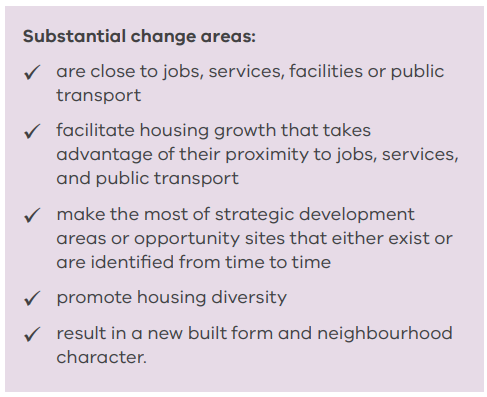
Example of residential development framework

What does it mean for you if you are thinking of subdividing?
DELWP recognises the tensions between councils and developers around housing growth and neighbourhood character objectives. DELWP suggests local councils to develop a residential development framework which identifies minimal, incremental and substantial change areas; to balance the need to protect valued character with the need to ensure housing growth and diversity. These Planning practice notes will provide guidance to local governments on how to apply new zones and how to structure their local residential development framework.
What is most encouraging for those that are thinking of subdividing their property, is that these frameworks can provide certainty for the community about where changes are likely to occur as well as expecting in what form it will take.
With councils clearly outlining what is the definition of Preferred Characteristic for each area and what is meant by respecting the characteristic of an area in a Preferred neighbourhood character statements; applicants can design their subdivision project with confidence, knowing the chances of their application being refused by council because of not respecting the local preferred characteristic is much lower.
Port Phillip council is proposing Amendment C142 to its planning scheme that will see 140 new properties included within its heritage overlays.
The extension of the heritage overlays will now include properties that the council believe are ‘Significant’ or ‘Contributory’ heritage places, allowing for more planning controls on these properties.
The amendment expands the scope of both Heritage Overlay 6 (HO6) and Heritage Overlay 391 (HO391), broadening the buildings and streets that are included within them.
HO6 comprises St Kilda East bound by Wellington Street / Dandenong Road to the north, Orrong Road to the east, Argyle and Inkerman Street to the south and St Kilda Road to the west.
HO391 comprises Alma Road to the north, Alexandra Street to the east, Mooltan Avenue to the south and Hotham Street to the west.
14 Raith Court in St Kilda East will be removed from the heritage overlay.
The amendment is part of an on-going program by Port Phillip Council to review heritage precincts within the municipality in order to address what the council say are gaps in the current heritage precincts.
The council state in their explanatory report that the amendment updates overlays so heritage controls remain current and reflect best practice to assist in their conservation.
Port Phillip council has strict controls compared to other councils in Victoria, as a large part of the municipality is already protected by a number of heritage overlays.
The amendment can be read in full here.
What is a heritage overlay?
A heritage overlay is an area identified by councils to be protected due to the historical nature of certain buildings contained within. The overlay allows greater planning controls within an overlay to ensure that heritage buildings are conserved and that new development does not have a detrimental impact.
Amendment C142 to the Port Phillip Planning Scheme
Below shows the areas that will be affected by the amendment:

The amendment will affect homeowners and developers of newly included buildings as they will now have to apply for a planning permit for most buildings and works which means additional costs as well as added time to the development process.
There are three categorises of buildings in a heritage overlay:
Significant heritage places
These buildings and surrounds have the strictest controls as they are individually important places of either State, regional or local heritage significance. Some of these places may be listed on the State Heritage Register which requires approval from Heritage Council Victoria for any works or changes.
Contributory heritage places
These include buildings and surrounds that are heritage places of local significance which directly contribute to the significance of the Heritage Overlay. However they have less controls than significant heritage places.
Non-contributory properties
These are buildings that do not add to the heritage significance of an area but are included in a heritage overlay. These buildings are controlled under the overlay as any new development may impact the overall heritage significance of a place. They have the least controls as they do not directly contribute to the heritage of the area.
Do I need a planning permit to develop my property in a heritage overlay?
Buildings in heritage overlays require planning permits for a broad scope of works. This is to protect the heritage significance of the buildings and area.
Under the Heritage Overlay, a planning permit is required from the council to:
subdivide land
demolish or remove a building (including part of a building)
construct a building (including part of a building or a fence)
externally alter a building
construct or carry out works
construct or display a sign
externally paint an unpainted surface
externally paint a building if the painting constitutes an advertisement.
Other controls may also apply such as internal alteration controls and controls over trees.
Applying for a Vicsmart planning permit in a heritage overlay
However minors works such as external painting of a building or constructing a fence can usually be applied through a Vicsmart planning application.
These type of applications are approved in 10 business days and have significantly lower application fees than a regular planning permit application.
Buildings and works in a Heritage Overlay that can be applied through Vicsmart:
• External painting
• Construct a fence
• Construct a carport, garage, pergola, verandah, deck, shed or similar structure
• Construct and install domestic services normal to a dwelling
• Construct and install a non-domestic disabled access ramp
• Construct a vehicle cross-over
• Construct a domestic swimming pool or spa and associated mechanical equipment and safety fencing
• Construct a rainwater tank
• Construct or display a sign
• Lop a tree
• Construct or install a solar energy facility attached to a dwelling
• Construct and install an electric vehicle charging station
• Construct and install services normal to a building other than a dwelling, including chimneys, flues, skylights, heating and cooling systems, hot water systems, security systems and cameras, downpipes, window shading devices, or similar
The amendment will be independently assessed by a Planning Panel this month. The Minister for Planning will then decide whether to adopt the amendment into the Port Phillip planning scheme following on from the Planning Panel’s report.
Combustible cladding is a major issue throughout Victoria and the government have committed to fund works to remove unsafe cladding following hundreds of high risk building being identified.
In 2017 the Victorian Cladding Taskforce was set up to address the issue and established a state wide audit. To date the audit has inspected over 2,200 buildings across the state.
Of the buildings that have been inspected 1069 buildings have been found to have combustible cladding. 72 have been found to be an extreme safety risk and a further 409 buildings have been found to be a high safety risk.
The audit involves an inspection of a building, followed by an assessment by an expert panel who assign a risk rating to the building.
The Cladding Taskforce released a report this year with 37 recommendations to overhaul the state’s approach to cladding. It addresses the systemic issues that led to unsafe cladding being used and the need for regulatory building reform.
Cladding Safety Victoria
The recently established Cladding Safety Victoria is one of the key recommendations from the report. This governing body has been set up as a one stop shop to oversee the removal of combustible cladding and provide funding and support to owners.
Buildings which have been audited and found to be high risk are referred to Cladding Safety Victoria who organise the rectification works with the highest risk buildings being prioritized.
15 buildings have been identified as the most at risk and will have their cladding fixed first. This includes the Neo 200 complex on Spencer Street, Melbourne which caught fire this year and required more than 80 firefighters to put out the blaze.
However moderate to low-risk buildings will not be eligible for funding and it will fall on the owners to foot the bill for removing combustible cladding. The government have estimated it will take at least five years to complete the rectification works.
Three classes of buildings have been included in the audit all built after March 1997 when combustible cladding began being widely used:
• Class 2 buildings
Apartments that are three or more storeys.
• Class 3 buildings
Hotels, motels and student accommodation that are three or more storeys.
• Class 9 buildings
Hospitals, schools and aged care facilities that are two or more storeys.
The Victoria government has committed $600 million to help with the cladding crisis which will be delivered by Cladding Safety Victoria. However as the auditing continues more buildings will require funding to remove unsafe cladding and the cost to fix all high risk buildings has been estimated by some to run into the billions.
Increase cost of building permits
It was announced in July that $300 million of the $600 million state budget for the works will come from taxpayers. The government will make up the other $300 million shortfall through a levy on building permits on buildings which have a cost of works of more than $800,000. This is the result of the Federal Government’s refusal to contribute to the fund due to the cladding being deemed a failure by state building regulations, and therefore the state’s responsibility.
This will have a big impact on developers who will now have to pay higher fees for building permits. It has been estimated that the increase will apply to about six per cent of building permits but will exclude low-rise buildings such as single dwellings and townhouses. The Government is proposing a 700 per cent increase in the levy for new buildings valued at more than $1.5 million. For works around $800,000 the levy rate will double.
The Cladding Crisis
Combustible cladding has been used in the building industry in Victoria over the past 20 years mostly due to its low cost as well as its light weight and insulating properties.
There are two types of cladding used on buildings that have been found to be flammable. These are aluminium composite panels or ‘ACP’ and expanded polystyrene or ‘EPS’. These types of cladding escalate fires quickly and cause them to spread.
The dangers of cladding were brought to public attention in Victoria following the 2014 fire at the Lacrosse building in Docklands. It was the first major building fire in Victoria caused by combustible cladding.
However this was only the start of concerns as in 2017 the Grenfell tower fire in the UK claimed the lives of 72 people. This put major pressure on Governments to tackle the problem and was a wakeup call for the Victorian State Government who the same year introduced their Cladding Taskforce.
How to find out if your building has combustible cladding
If you want to know if your building has combustible cladding speak to the owner’s corporation or building manager who will be able to confirm if the building has been audited and what the results were.
You can look up the number of buildings with combustible cladding in your municipalityhere. If you are looking at purchasing an apartment or building VBA have released a fact sheet to help.
The Victorian Government have also announced they will be undertaking a review of the state’s Building Act to identify what legislative changes are required to better protect consumers.
Cladding Safety Victoria have released a list to improve safety measures in buildings; such as:
• installing smoke alarms
• fixing/unlocking emergency exits
• removing ignition sources
• Steps you can take to reduce the risk from cladding
• Extinguish cigarettes safely
• Keeping hallways clear to avoid obstructing occupants needing to exit the building
• Not covering air-conditioning units with clothes or other materials
• Keeping balconies clear of clutter and material such as clothing, boxes or rubbish
• Ensuring barbecues and heaters are not used near combustible material.
• Ensuring smoke alarms inside apartments are not covered or disconnected
• Keeping fire stairwells and landings clear and not to store items within them
If you are an owner or owners corporation you are also legally required to:
• Ensure the alarm and fire extinguishers have been maintained
• Keep fire doors clear of obstructions, closed and unlocked at all times
• Ensure all occupiers know the building’s evacuation plan and fire safety procedures
The Better Apartments in Neighbourhoods Discussion Paper 2019 has been released by the Victoria State Government DELWP. It is proposing several recommendations for apartment developments which will improve their design and liveability for residents and the neighbourhood in which they are built.
Apartments are an essential part of residential development in Victoria helping with the pressures from an ever increasing population and creating affordable housing. It is forecast that by 2051, Victoria’s population will increase by over four million people with an estimated 1.9 million additional households.
The DELWP is asking for feedback on the changes from the Victorian public who can make a submission to them online. The proposed changes outlined in the paper will only affect apartment buildings which are identified as residential developments five or more stories high.
In 2017 the Victoria Government introduced the Better Apartments Design Standards which was a response to concerns that apartments were ‘not providing safe and healthy environments.’
Victoria’s Better Apartments Design Standards are implemented in all planning schemes across the state through the Victoria Planning Provisions (VPP).
This Discussion Paper is a continuation of this to further improve apartment design and development.
What are the new changes to apartments?
There are five new measures that are proposed to improve apartment developments in Victoria which include: green space, wind effects, appearance of apartment buildings, street interface and constructions impacts.
Below is a summary of the proposed new standards:
Green Space
The discussion paper outlines the need for improved landscaping and more communal green space in apartment buildings. The paper acknowledges that landscaping is often an afterthought and is not being utilized effectively. It also notes that landscaping is often limited along the front of apartment buildings which causes a less attractive streetscape. Currently, smaller apartment do not have a communal green space requirement, leaving a lot of residents without gardens. Only apartments with 40 dwellings or more need to provide open communal space of 25m2 as a minimum, smaller apartment developments have no obligation to do so.
Recommended changes:
- Encourage landscaping in street frontages
- Clarify current landscaping objectives and encourage more canopy tress as part of the landscaping
- Remove the threshold so all apartments will have a mandatory communal open space for residents of at least 25m2.
- A planning permit condition about how the landscaping will be maintained.
Wind effects
Presently there are no specific planning requirements to manage wind effects caused by a development. It is noted that tall buildings can increase wind which in turn can cause safety and amenity hazards for the public.
Recommended changes:
- Ensure wind effects are considered when developing a site
- Define comfortable and unsafe wind conditions to assess wind affects
- Clarify when a desktop wind study or wind tunnel analysis may be required
Appearance of apartment buildings
In inner cities areas such as central Melbourne apartments are very common and therefore design and development controls apply helps control the external look of buildings. However these controls are not applied in more suburban areas where apartments are now becoming increasingly popular. The changes will address the lack of external building controls in these less central areas of Victoria and make sure apartments are built with durability, attractiveness and easy maintenance in mind.
Recommended changes:
- New standard to require apartments to have a visually interesting, high-quality external design with external materials that are durable.
- New standard for apartments to have external walls that are accessible for maintenance.
Street Interface
Apartment buildings can often create poor street interfaces, which undermine safety and detract from the look and feel of a street. The current Better Apartments Design Standards do not sufficiently emphasise the need for street interface design to integrate building services and the other functional requirements of an apartment building. The proposed changes will help apartments better integrate with the surrounding streetscape and be more attractive to the public.
Recommended changes:
• Integrate the layout of developments with the street and encourage active street-level frontages
• Minimise the impact of vehicle crossovers and access points on the streetscape
• Ensure site services are accessible, adequate and attractive.
Construction Impacts
It is noted in the discussion paper that apartments often take a long time to build which causes several issues in the surrounding neighbourhood which need to be managed correctly. These include traffic, road and footpath closures, dust, odour and noise emissions. Currently construction issues are managed by individual councils and there is no clear consistency in the best practices.
Recommended changes:
•Developers will have to identify how they will manage and mitigate issues for the surrounding area caused by the construction.
•Suggested condition of a planning permit for developers to submit a construction management plan to be approved by council.
What affect will these changes have?
The proposed changes will have an effect on development costs of new apartment buildings particularly the green space requirement as all developers will be required to incorporate communal green space into their design. This means more expense when developing new apartment buildings which in turn will affect the affordability of apartments. However to what extent these changes will have an effect remains to be seen. Overall it will improve the amenity of apartment buildings for residents with more communal spaces, make apartments less of an eyesore in neighbourhoods and will alleviate tensions between developers and local residents during the construction stage.
What happens now?
All Victorians are invited to make a submission to the DELWP regarding the proposed new measures which can be made online via an online submission form. Submissions close on Friday 27 September 2019 at 5 pm. DELWP will consider the submissions when making recommendations to the Planning Minister.
An extensive report has been published into planning permit applications throughout seven councils to help improve the application process and avoid delays for developers. The Growth Area Councils Permit Assessment Health Check Report has looked at seven growth area councils to understand how they are performing when it comes to processing planning permit applications. The health check report said it will allow councils to ‘make good decisions; faster.’
The report was undertaken as part of the Streamlining for Growth Program funded by the Victorian State Government and managed by the Victorian Planning Authority (VPA).
What are growth area councils?
Growth areas are municipalities that have been identified as areas intended for increased development and expansion of housing and infrastructure. Growth area planning is unlike other planning permit processes as they are primarily applications for multiple lot subdivisions. These types of projects require developers to enter into an agreement with council to provide certain public assets in order to complete the subdivision of their lots. The public assets include roads, essential services, open space, drainage infrastructure among others. This is to make sure that the area can accommodate the increase in housing and people that the subdivisions create. However developers are concerned over long approval times along with inconsistences within the seven council’s processes.
The seven growth area councils in the report are: Casey, Cardinia, Hume, Melton, Mitchell, Whittlesea and Wyndham
The Report
The report gathered both qualitative and quantitative data giving a comprehensive insight and ‘nuanced narrative’ into how efficiently planning applications are processed throughout the councils. The report recognises how planning permits in growth areas are becoming increasing complex due to the amount of internal departments and external referrals that are involved.The report found all seven council follow the same overall structure when it comes to the planning permit process. However there were many differences in how the councils operate throughout the process. It looked at the whole planning process from pre-application all the way through to the statement of compliance and approval from council.
The Four Key Benchmarks for planning permit application.
Four key benchmarks where used to evaluate each councils strengths and weakness and see how they compare with each other.
- Scale + Maturity
This benchmark looked at the scale of growth of each of the councils along with the length of time they have been a growth area council.
All the councils were found to have an increasing growth in scale. Cardinia, Mitchell are both newly emerging growth areas and along with Hume will have a big increase in growth putting pressure on these councils, with the rest continuing to grow at a steady pace. Casey and Wyndham are the most longstanding growth councils with Casey reaching its peak volumes of growth.
- Communication + Culture
This benchmark looked at how councils work internally to reach planning application decisions and how they interact externally with developers.
Melton was found to have the highest level of openness and transparency both within their council and externally with developers. Hume had the lowest levels both internally and externally. Casey and Whittlesea where second highest with Cardinia, Wyndham and Mitchell coming in third.
- Process
This benchmark looked at approval timeframes at different stages of the assessment process. Along with how comfortable councils are at adapting processes and accepting risk to achieve better development outcomes.
The results found Hume was the slowest at processing planning applications of all the councils along with Wyndham, Whittlesea and Mitchell all having slow approval timeframes. Cardinia had the overall best approval times with Casey and Melton being middle of the range.
Wyndham have the strictest approach to planning permit applications making them less likely to be open to different types of developments followed by Hume then Casey. Melton is the most open and adaptable but will start to become stricter due to their past flexibility being ‘exploited by developers’. Cardinia is the second most open and flexible with planning applications along with Melton and Whittlesea both coming in third out of the seven councils.
- Resources
This benchmark considered the resources Councils have at their disposal when processing planning permit applications. This included the number of employees and their roles within growth area departments and the current technology used by council when processing planning applications.
Melton, Whittlesea and Wyndham were found to be well resourced but both Whittlesea and Wyndham were currently working at capacity for their planning applications. Casey has a ‘relatively lean team of officers’ but a ‘well-developed organisational structure.’ Hume’s small team were found to be stretched by the volume of applications and growth of the area. Cardinia was found to be a small but effective team that would benefit from more resources. Mitchell currently has the smallest growth area planning team consisting of a single statutory planner and an engineer. But as they are transitioning to a ‘fully-fledged growth area council’, they are investing in a bigger team of staff. Casey and Cardinia were found to be the most technologically progressive of the seven councils and Melton and Whittlesea the least.
The report also identified 5 key themes that are causing issues and delays during planning decisions throughout the seven councils which include:
- Growth area planning is not a standard planning permit assessment process asdevelopers are delivering public assets which make them more complex to assess
- There is a disconnect in expectations between the development industry and Council
- Lack of space for genuine negotiation and compromise between council and developers.
- Technology barriers at organisational level during the application process
- Skills and expertise shortage in councils
There are seven stages of a growth area planning permit application which include:
- Pre-application
- Referrals and Further information
- Permit assessment
- Certification
- Plan approvals
- Statement of compliance
Key areas of planning application delays were identified as the ‘Referrals and Further Information’ and ‘Planning Approvals’ stages as: “These stages require consultation with and negotiation between a range of internal and external parties before arriving at a decision.”
Action Plans
A general action plan was created for all seven councils along with individual actions plans for each of them. These include clearly outlined objectives that are to be met along with measures of their success.
“The action plans developed for each council seek to address the causes of these delays, by improving transparency, clarifying roles and expectations of various parties, and building a greater sense of trust between councils and the development industry. Some actions are best undertaken as a collective of growth area councils, whilst others are best undertaken by the individual council,” said the report.
Two actions have been chosen by each council as a priority from their biggest weakness identified by the four benchmarks. These can be seen below and were taken from the full report which can be found here.
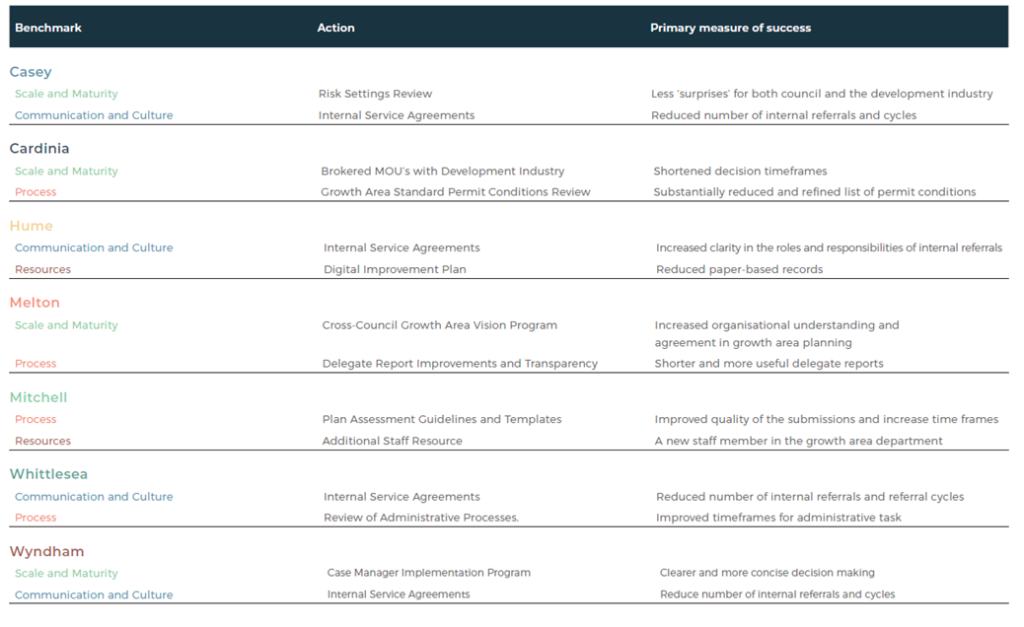
What does this mean for planning permit applications?
This report along with the action plans it has produced will no doubt create more transparency and cohesion within the councils and with developers during the application process. It is an extensive report which, if the action plans are followed, will help developers and council achieve better outcomes and faster application times for planning permit application in these growth areas.
Monash Council are seeking to introduce a new public open space contribution rate of 10 percent which will be implemented across the whole of the municipality for subdivisions. If implemented the amendment will see people paying up to 400% more to Monash council in contribution rates subdividing lots into three or more. Currently if you own a site in Monash worth $2,000,000 and successfully subdivide it into three lots you are required to pay 2% of the value of the land ($40,000) directly to council for future public open space. Under the amendment proposal you will be required to pay $200,000 to council as the contribution for private open space. That is a 400% increase.
The Amendment:
•Amends the Schedule to Clause 53.01 to require that all subdivision provides a public open space contribution at a rate of 10%.
•Introduces a new Local Planning Policy – Clause 22.15: Public Open Space Contributions Policy that sets out the guidance for the process on when, where and how a public open space contribution will be required, including whether in the form of cash in lieu, land or a combination of both.
•Replaces Clause 21.10 in the Municipal Strategic Statement with a new Clause 21.10.
Monash has followed in the footsteps of Frankston City Council who earlier this year proposed to increase their public open space contribution rates. However Monash have taken a much more heavy handed approach increasing their rates to one of the highest of any council.
Frankston set its rates between 2% and 8% with the highest rate of 8% only payable for subdivisions within the Frankston Metropolitan Activity Centre which has a higher population density and higher land value than in other areas of Frankston. Currently contribution rates in Monash are between 2% and 5% depending on the number of lots created but the new amendment does not take into account the number of lots or the location of the subdivision instead it is a blanket 10% rate for all subdivision in Monash. Under the new amendment those doing a 3 lot subdivision will pay the same 10% contribution rate as a person doing a 20 lot subdivision.
Below is the current public open space contributions rates in Monash
Number of lots Amount of contribution for public open space
3 lots 2%
4 lots 3%
5 lots 4%
6 or more lots 5%
What are public open space contributions?
When land is subdivided into 3 or more lots it is a requirement that a developer pay a contribution of the site value to the council. This is then used to create open spaces such as public parks, playgrounds and reserves. The contribution is either a percentage of the site value, a land contribution or a combination of the two.
Why the increase in contribution rates?
The new rates will see a major increase in revenue for the council which will provide funding for public open space project. Monash reports that by 2028 there will be an increase of 14,057 people to the Monash population increasing demand for public open space areas within the municipality.
Monash have deemed the increase as ‘necessary to deliver a reasonable standard of open space provision across the whole of Monash for a growing population’.
They said: “This contribution rate reflects the need to ensure that all residents in the future have contributed to providing an appropriate level of public open space services and recognises a need of 30 square metres per person.”
What does this mean for developers?
This amendment will have a serious effect on property developers hitting small developers particularly hard. Currently a 3 lot subdivision only attracts a rate of 2% which will be increased to five times that amount under the new amendment. Larger developers may be able to absorb the extra cost and still make a profit whereas this will not be the case for everyone. In the short term it will see developers fast forward their projects to avoid paying the new rates. But in the longer term it may see smaller scale developments being stifled. Two lot subdivisions will remain exempt from making any public open space contributions.
Are you affected by the new contribution rates?
Amendment C148 commenced public exhibition on Monday 17 June and will end on Monday 15 April 2019. People will have until then to make submissions to the council for consideration. Any person who may be affected can make a submission to the planning authority about the amendment. Please contact us if you will be affected by the amendment and we can prepare a professional submission on your behalf to Monash council via post or email. Your name and contact details are required for council to consider your submission, and to notify you of the opportunity to attend Council meetings and any public hearings held to consider submissions.
An independent planning panel will consider the Amendment and each submission that Monash Council receives. The week of 23 September 2019 and the week of 21 October are the dates currently proposed for the panel hearings.
More information about the amendment, including the amendment documents are available on the City of Monash website.
Developers will no longer be able to avoid paying stamp duty by entering into an agreement to develop a site without purchasing the land from the landowner.
Developers are now treated as having beneficial ownership of any site worth more than $1 million and will be subject to paying 5.5% stamp duty on potentially the entire value of the land.
These new provisions under the State Taxation Acts Amendment Act 201 brought in by the Victorian Government came into effect on 19th July.
Is has been introduced to help off-set the projected $5.1 billion shortfall in stamp duty expectations following the decline in Victorian property values from their 2017 peak.
Previously stamp duty was generally not payable by developers if there economic entitlement was less than 50% of the development. This threshold has now been removed and developers will be liable to pay stamp duty on any economic entitlement regardless of the percentage.
What is economic entitlement?
A person who enters into an agreement in which they are entitled directly or indirectly to obtained an economic benefit from the land.
A person acquires an economic entitlement if the person is entitled to any one or more of these:
• To participate in the income, rents or profits derived from the land.
• To participate in the capital growth of the land.
• To participate in the proceeds of sale of the land.
• To receive any amount determined by reference to any of the above matters.
• To acquire any entitlement described above.
When do developers have to pay stamp duty?
The stamp duty is payable when the economic entitlement has been acquired as the person has obtained an ‘ownership interest’ in the land which is then liable for stamp duty.
It is payable upfront when the economic entitlement is agreed upon not when the developer receives the entitlement. It is calculated by the percent interest the developer has obtained based on the market value of the land at the time of the agreement. It is not determined by the end value of the development.
The economic entitlement is treated as obtaining a beneficial interest in the land. The amount of stamp duty payable is dependent on the percentage of the beneficial interest acquired by the developer. Therefore if the land is valued at $10 million and the developer has acquired an economic entitlement of 10 percent they then will have to pay stamp duty of $55,000 (5.5 percent of their 10 percent interest)
The beneficial interest will be equal to:
The percentage of the economic entitlement that is acquired; or
100% if:
- the percentage of the economic entitlement is not specified or cannot be determined;
- there is a percentage specified, but the person or their associate is entitled to other amounts; or
- two or more economic entitlements of different types are acquired.
Developers will need to make sure that a clear percentage of interest is identified in any arrangement with land owners to avoid being treated as having a beneficial interest of 100 percent and being charge 5.5% stamp duty on the whole of the land value. However in these cases developers can apply to the Commissioner of State Revenue who can lower the percentage if they see fit.
What does this mean for developers and the Victorian housing market?
The changes will have major implications for developers who may now start to rethink develop agreements with land owners and be put off from certain development projects all together.
Development Company Resi Ventures have warned that the changes will reduce supply and increase land prices for buyers.
Already they have said they will walk away from a 900-lot house and land project in Melbourne West following the changes.
“Imposing a tax upfront is a draconian measure, stamp duty is not normally paid until settlement so this accelerated taxing treatment will torpedo a number of deals Resi Ventures has in the pipeline,” Resi Ventures director Mr Anthony Braunthal said.
Mr Braunthal believes that the Victorian Government will not receive the ‘tax windfall it expects’ and may even see revenue fall.
“Developers are the very organisations that create jobs and pay significant amounts of tax. More should be done to drive affordability down by reducing regulation and taxation – not increasing imposts on development,” he said.
Franchise gyms such as ‘Anytime Fitness’ ‘F45’ and ‘9 Round Fitness’ are becoming commonplace in suburbs throughout Victoria. These traditional and classed based fitness centres require planning permits from local councils prior to opening. We have secured planning approval for a vast array of gym types around Melbourne and Victoria including popular gym franchises, ‘Anytime Fitness’ and classed based concepts such as ‘F45’ and ‘9 Round fitness’. Here are some useful tips if you are opening a gym along with what you will need as part of the planning permit process.
Don’t pay more than you have to
Planning approval can take months to be obtained and you don’t want to be paying out for a lease months before the gym is operating. Apply for your planning permit before you begin paying rent or make sure to insert a clause that makes the lease subject to a permit being approved by council. Very often landlords are open to such terms and will offer you the time required to secure a planning permit before you begin paying rent. Make sure to negotiate a good rent free period of at least three months to allow you to obtain the planning permit.

Talk to your neighbours before lodging an application
If you have apartments or residential houses next to your premises it is very important to approach them directly to introduce yourself as the business owner and to ask them if they have any concerns with you opening a gym next to them. If you encounter a lot of objections from nearby existing neighbours to things like early class times or loud music then this will make it more difficult to obtain council approval. There is far less public opposition to gyms in existing commercial or industrial areas where there is no existing residential houses or apartments close by. Properties in these locations often receive a planning permit with a lot more ease and within three months of applying to council.
What you will need for your gym planning application
- Development Plans
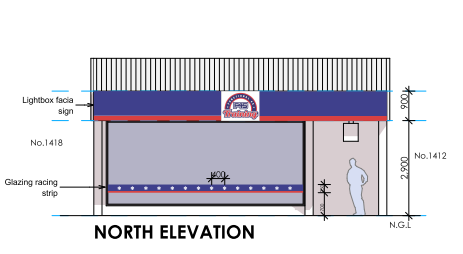
You will need floor plans showing the internal layout of the gym along with ‘proofs’ of any signs that will be displayed on the building to advertise the gym. An example of such ‘proofs’ is shown below.

A 9 round fitness gym in Melbourne CBD. We have obtained approval from many gym franchises in Melbourne helping gym owners open their businesses in the ever expanding market.
- Town Planning Report.
We complete a town planning report that outlines the proposal and how it complies with the relevant planning scheme. This is a mandatory requirement of the application and includes information about proposed class times, number of staff on site and opening times.
- Acoustics report.
An acoustics report may be required as part of the planning application and is done by a qualified acoustics consultant. This report will be a requirement if you have neighbouring residential properties. If your premises is not close to any residential or other sensitive land use then this report will not be required. The report measures the amount of noise that will be caused by the operation of the gym. It will outline how noise will impact the amenity of neighbouring tenancies and the surrounding area and how it will be controlled. As part of this report the acoustics engineer may require you to install noise absorption measures such as rubber flooring or double glazing. This will be particularly relevant for 24 hours gyms or gyms with music and early morning classes which may cause noise disturbance.
- Traffic report
Similarly a traffic report will likely be needed to assess the effect of an increase in traffic from people attending the gym and how this will be managed. A traffic report is likely to be required if you have no off street car parks allocated for patrons of the gym. This is very common for gyms and Council frequently approve planning permits for gyms with no car parks on site. This report is required to demonstrate to council that the absence of car parking will not create a local traffic issue.
The planning permit process once the application is lodged
Once the above items have been prepared your planning permit application can be lodged to the local council. On average it takes councils 3 – 4 months to process a planning application and issue a permit. Below is a outline of the steps that occur after lodgement:
- A letter will be sent from council informing us that the application has been accepted and allocated to a council town planner to assess. The town planner will be the point of contact at council and will oversee the application from start to finish, ultimately deciding whether to approve it.
- Within 28 days of the application being accepted council may request further information. This is requested in approximately 90 percent of all planning applications. The information request can range from amending parts of the plans to providing additional information to help decide the application. A deadline will be set for when the information has to be provided and is usually around two months.
- Once the further information has been received by council the application goes to public advertising. A sign is erected on the site advertising the application to the public for a period of 14 days. Council also send letters to neighbours and property owners that will be affected by the application to notify them of the application and give them the opportunity to comment. These comments typically come in the form of objections.
- If there are several objections to the application a consult meeting will be held. This is where both the applicant and objectors make submissions to the council. A consult meeting may lead to reduced hours of operation or reduced class times to gain council support.
- If there have been objections to the application then a notice of decision (NOD) to grant a permit will be issued. This gives objectors 28 days to appeal the approval at VCAT if they wish. Once the 28 days have lapsed and no VCAT appeal has been made the permit will be issued.
- If there have been no objections to the application a permit will be issued with conditions attached to it. Once these conditions have been met the council will endorse the floor plans and ‘proofs’ of any signs. This makes up your full planning approval and you are ready to move on to obtaining your building permit.
Remember the entire process can take 3 months so allow for this when negotiating your lease. If you have a lot of public opposition to your application from neighbours the process will take longer.
If you are opening a gym and want to ensure approval with the help of professional town planners then contact us on 03 98241902 and we would be happy to discuss your project.
The Coalition Government has promised to make housing more affordable by lowering deposits for first time buyers. Housing affordability is an ongoing issue in Australia particularly for younger people trying to get a foot on the property ladder. To help remedy this the Collation Government announced a First Home Loan Deposit Scheme. Under the new scheme eligible first time buyers will only need a 5% deposit for a mortgage rather than the usual 20% with the government making up the shortfall. But what will this slash to mortgage deposits actually mean for first time home buyers and how will this affect the housing market?
The government has committed 500 million to the fund the scheme and it will it be administered by the National Housing Finance and Investment Corporation starting from January 1st.
Along with decreasing deposits, the scheme will also exclude people from paying costly lenders mortgage insurance. This is normally required by lenders on deposits under 20%. It protects them if home owners can’t afford to meet their repayments and can cost around $10,000 or more.
Who is eligible?
The loan is available to single first time buyers earning up to $125,000 a year or couples earning up to $200,000 a year.
The government have said that the new loan will be capped at 10,000 people a year and will be on a first come first serve basis. This is a small percentage of first time buyers considering more than 110,000 Australians bought their first home in 2018.
However this seeming fix to home ownership and affordability may actually leave first time home owners paying more in the long term.
Research by Ratecity found that currently a $500,000 mortgage with a 20% deposit would mean monthly repayments of $1,982 a month over 30 years. Whereas a 5% deposit would see monthly repayments increase to $2353 a month over 30 years and paying an extra $58,774 overall.
The research did find that the scheme would sustainably decrease the amount of time it would take for people to save for a deposit. Based on average house prices would-be home owners in Melbourne who save $400 a week would be able to afford the 5% deposit over 4 years earlier than saving for the 20% deposit.
However RateCity research director Sally Tindall warned first time buyers to be cautious as they will be ‘signing up to a 30-year mortgage with a wafer-thin deposit.’
She said that starting with such a small deposit will see people making higher monthly repayments and shelling out thousands more in interest to the bank over the life of the loan.
“Don’t rely on the government to tell how much you can borrow. Do the maths yourself, taking into account things like extra interest versus not having to pay rent or lenders mortgage insurance, and work out whether a 5% deposit is a good idea for your financial future. You may find you’re worse off in the long run,” she said.
What will this do to house prices?
Housing prices have been steeply falling in Australia and this scheme could see a turnaround for the housing market with more demand driving up house prices. Prime Minister Scott Morrison said that the policy would have a “firming” effect on falling house prices.
However Brendan Coates and John Daley of Grattan Institute warned in an online article forThe Conversation that the scheme will have little effect on increasing home ownership for the masses. The 10,000 person a year cap is around one in every ten mortgage loans which they estimate would make home ownership ‘only 1 per cent higher in a decade’s time.’
They also warned that it will be counterproductive to housing affordably if the 10,000 person cap is lifted, which has been suggested by the Coalition Government.
“If it “succeeded” in rapidly expanding demand from first home buyers, it would push up prices for everyone, not least all the other first home buyers trying to get into the market,” said Brendan.
Whether good or bad in the long term the news will be welcome to property developers who rely on first home buyers to purchase their new development.
A new Planning and Environment leader will be appointed at VCAT following the planned retirement of the current leader. Senior Member Teresa Biscussi will lead the tribunal’s Planning and Environment list from July 1st 2019 after being appointed by VCAT President Justice Quigle.
Teresa Biscussi will take over the role from Deputy President Helen Gibson who is retiring at the end of June this year. Teresa joined VCAT as a Senior Member in 2018 previously working as a Principal for a legal firm in Melbourne. Her legal career has focused on planning law and encompassed regular appearances at VCAT, Planning Panels Victoria, Heritage Council, Magistrates’ Court, and the Victorian Commission for Gaming and Liquor Regulation.
VCAT described Teresa as an ‘experienced and highly skilled professional with a longstanding commitment to community service’ and that her ‘wide experience will stand her in good stead in this important role.’
VCAT thanked Deputy President Helen Gibson for her time as leader and said: “We celebrate the enormous contribution of Deputy President Gibson, who has led the Planning and Environment List from 2004 to present.”
Before becoming the leader of Planning and Environment Helen Gibson was the inaugural Chief Panel Member of Planning Panels Victoria from 1996 up until 2014 when she took the leadership role at VCAT. She participated on many planning reviews and advisory committees, including as an Expert Group Member on the Review of the State Planning Policy Framework from 2008 to 2010. In 2016, Helen was named a Member of the Order of Australia for significant service to planning and environment law in Victoria, and as a role model for women in the profession.
VCAT lists, cases & planning permit decisions
VCAT is made of a President, Vice Presidents, Deputy Vice Presidents, Senior Members and Members. VCAT members are appointed to oversee VCAT listings and hear and decide cases. VCAT has different lists each dealing with cases of a similar nature. All Planning and Environment list members have expert planning knowledge and usually come from planning backgrounds. Planning appeals are heard by a VCAT member who will decide the case after hearing from both parties.
A full list of VCAT member can be found here.