

When lodging a planning application it is important to make sure your plans and the information provided are as accurate as possible. This is especially important if your town planning application ends up going to VCAT.
The most common inaccuracies seen in planning applications are mostly to do with existing conditions of neighbouring sites such as the following:
• Shadowing to neighbouring properties
• Location of windows and doors of neighbouring properties
• Tree locations of neighbouring properties
• Features of neighbouring properties
It is not enough to accurately map out your own properties site conditions you also have to accurately show neighbouring property conditions as well.
VCAT application for review
Tika v Yarra CC Red Dot [2018] VCAT 894 was a recent VCAT case that was made a red dot decision. It highlights the importance of accurate information and plans, particularly when it comes to assessing the impact of a development on neighbouring properties. The VCAT appeal involved a development proposal for two 3-storey dwellings. The application was approved by Yarra City Council even though there were numerous inconsistencies and inaccuracies in the plans. The council approval led to an appeal from objectors regarding the decision at VCAT.
The applicant had significantly overestimated the amount of private open space on both their site and their neighbour’s site. Habitable windows and glazed doors were incorrectly shown, dwellings were incorrectly labelled as outbuildings, the footprint of neighbour’s buildings was wrong and existing trees on the neighbour’s site were either not correctly depicted or absent from the plans.
VCAT planning decisions
The permit applicant also did not meet the planning objective for overshadowing of open space when assessed correctly by VCAT. The objective ensures buildings do not significantly overshadow existing secluded private open space.
The overshadowing of open space Standard B21 Clause 55.04-5 is as follows:
‘Where sunlight to the secluded private open space of an existing dwelling is reduced, at least 75 per cent, or 40 square metres with minimum dimension of 3 metres, whichever is the lesser area, of the secluded private open space should receive a minimum of five hours of sunlight between 9 am and 3 pm on 22 September.’
‘If existing sunlight to the secluded private open space of an existing dwelling is less than the requirements of this standard, the amount of sunlight should not be further reduced.’
The inaccuracies along with the amount of overshading of private open space led to VCAT overturning Yarra City Council’s approval and issuing a refusal for the development.
In its decision the tribunal stated:
‘While it should be self-evident, the absence of accurate information makes it very difficult to undertake an accurate and properly informed assessment of a proposal’s impacts. It is therefore important that accurate information is provided before the giving of any notice and before decisions are made on permit applications.’
It was also noted that:
‘This case highlights the need for permit applicants to provide accurate plan information showing existing conditions in relation to the review site and neighbouring land. Responsible authorities also have an obligation to endeavour to ascertain the accuracy of information submitted to it by permit applicants before requiring any notice to be given and determining a permit application.’
Amendment VC142 of the Victoria Planning Provisions removed the requirement that the responsible authority had to inform the applicant in writing that the neighbourhood and site description is satisfactory prior to the giving of notice or determining the application. It was felt that deleting this requirement would reduce the administrative burden on councils and streamline the permit process for residential development.
Tika v Yarra CC Red Dot [2018] VCAT 894 case noted that although the above amendment was a positive change:
‘…it should not, however, be confused with the obligation for responsible authorities to critically review such information before determining whether the neighbourhood and site description is satisfactory. It remains that permit applicants must still submit a satisfactory neighbourhood and site description and the responsible authority must still be satisfied that the neighbourhood and site description is satisfactory before it requires notice of an application to be given, or before it decides an application.’
Although the council should be checking plans thoroughly and picking up mistakes the responsibly is with the applicant to ensure they have supplied accurate information so as not to end up with a refusal like the Tika v Yarra CC Red Dot [2018] VCAT 894 case.
Site access to neighbouring property
As highlighted earlier most inaccuracies are due to incorrect depictions of the neighbours existing conditions. It is up to the applicant to get access to the neighbour’s property to correctly depict the existing conditions. Neighbours have no obligation to let a permit applicant access their site which can lead to the applicant estimating certain conditions of the neighbouring site.
This highlights the importance of a good relationship with your neighbour during the planning application process. It is a good idea to talk to them about the application as soon as possible. This will let them know they are being listened to and consulted during the process. Getting their feedback in the early stages will make them more agreeable and less hostile to the application rather than finding out about the application when they receive notification from the council.
It is also better to ask for access to your neighbour’s house sooner rather than later. Asking for access late on into the planning process will mean they have had time to review the plans and may have decided against the application. Maintaining good relationships with your neighbours throughout the planning process is always an advantage to avoid objection and appeals to VCAT.
Remember just because council have not picked up inaccuracies in your plans or noncompliance issues in their assessment does not mean VCAT won’t address them. The VCAT member who will decide the case will have expert planning knowledge and incorrect information will be spotted.That is why accurate plans are essential when there is either an application for review by a permit applicant under section 77 Planning and Environment Act 1987 or an applicant for review by an objector under section 82 of the Planning and Environment Act 1987. Inaccurate information can and will most likely lead to a refusal as demonstrated in the Tika v Yarra CC Red Dot [2018] VCAT 894.
The minimum garden area requirement is a mandatory planning percentage in Victoria that applies to the construction or extension of residential building in the Neighbourhood Residential Zone and the General Residential Zone.
It ensures that a specific amount of a lot’s area is preserved as ‘garden’ and not built upon. This protects the greenspaces and neighbour character of a suburb and stops overdevelopment throughout Melbourne. The requirement has been in effect in Victorian Council Planning Schemes since March 2017 and a planning permit cannot be issued for a subdivision or development application by the local council if the garden area is not met. The mandatory requirement was introduced following the Department of Planning’s decision to abolish the ‘two dwelling maximum’ rule that existed in the former Neighbourhood Residential Zone. The measure was introduced to allow larger sites within the Neighbourhood Residential Zone of suburban Melbourne such as Banyule, Manningham and Glen Eira to be developed for more than two houses where lot sizes where excessively large. In the more metropolitan areas of Melbourne such as Stonnington and Yarra the measure was introduced to prevent buildings occupying entire sites and to ensure effective separation between buildings on adjoining lots was achieved by ensuring a landscape buffer was created around buildings.
However what is classed as ‘garden area’ and what is exempt from being included can be difficult to understand. It is important to be clear on what is permitted to ensure that your development is compliant with the Victoria State Planning Provisions along with your local planning scheme. If not you could be left with a development design that does not meet the minimum requirement and therefore will not be approved by your local council.
The required percentage is based on the size of the lot.
Lot size – Minimum percentage of a lot set aside as garden area
400 – 500 sqm – 25%
Above 500 – 650sqm – 30%
Above 650 sqm – 35%

The following are examples of what can be included to form part of the minimum garden area requirement.
What can be included under the Building Regulations
The width of any eave, fascia or gutter of a dwelling that does not exceed a total width of 600mm. This is not to be confused with a building overhang as shown in the diagrams below.
- A pergola
- Unroofed terraces, patios, decks, steps or landings less than 800mm in height
- A basement that does not project above ground level
- Any outbuilding that does not exceed a gross floor area of 10 square metres
such as:
- A garden shed
- A gazebo
- An arbor
- A pool house
- A green house
- A covered barbeque area
Domestic services normal to a dwelling or residential building including:
- Sunblinds and shade sails
- Flues and pipes
- Domestic fuel tanks and water tanks, heating and cooling equipment and other services
- Waste receptacle enclosures
- Letterboxes
Other structures:
- A swimming pool or spa
- A tennis court
- A retaining wall
- A fence
- A paved area
- A private bushfire shelter
Diagrams of the five most typical structures that emerge in the design of multi units and subdivision that can be included in the garden area calculation are shown below.


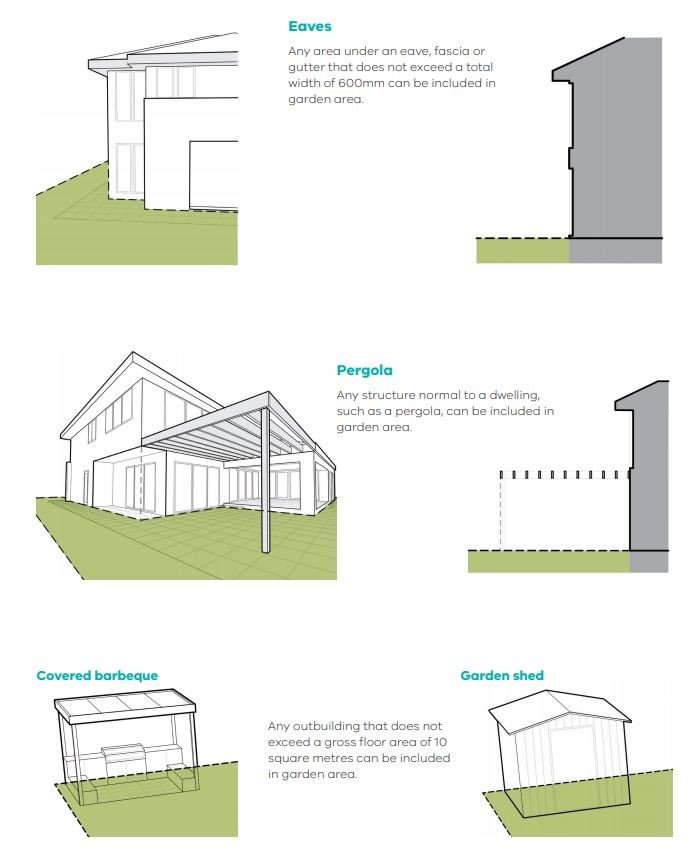
The following are the most common examples of exclusions and cannot be used to form part of the minimum requirement percentage:


Any area that has an upper storey building projecting over it is not classed as garden. Similarly an area under a balcony cannot be classed as garden. Driveways and areas used for car parking are all excluded along with basement carparks that project above the ground. A veranda, porch or alfresco that is roofed also cannot be included to make up the minimum requirement. If an eave, fascia or gutter of a dwelling has a width of over 600m then the area underneath is excluded as well.
The most common oversights of structures that are omitted from the garden area calculation and can be included are garden sheds or outdoor sheds less than 10 square metres in area and open roofed pergolas.
The most common oversights of structures that are incorrectly included in the calculation are front porches or areas under a first floor balcony.
These are the minimum garden area requirement rules throughout Victoria and is applied by the Victoria State Planning Scheme. There was much confusion in the calculation of the garden area when it was first introduced, particularly when calculating multi unit and subdivision development applications. To curb this confusion the Department of planning introduced a ‘Practice Note’ to assist designers of multi unit development and subdivisions understand what could and could not be included in the calculation. You can read the practice note here and it is critical to for designers and architects to understand what can and cannot be used in the calculation.
It is important for designers and architects to also know that there are a number of exemptions to the garden area requirement that exist. These exemptions are largely unknown and the most notable of which is:
- If the site is less than 400 square metres in area. This is a common occurrence in the inner suburbs and sections of Melbourne.
- If there is an existing building and it did not comply with the minimum garden area requirement before the 27th March 2017.
- If the lot is 400 square metres or greater and is designated as a medium density housing site in a precinct structure plan, an equivalent strategic plan or an approved development plan.
The reason these exemptions exist is because the lots less than 400 square metres in area that existed before the introduction of the minimum garden area requirement are typically found in older inner city areas of Melbourne where housing tends to be more urban in style with small front setbacks and compact rear yards or courtyards and in existing suburbs where land has been developed for villa units and town houses. Applying the minimum garden area requirement to these lots would unfairly limit the capacity to redevelop or renew existing dwellings.
The final diagram below from the practice note demonstrates the difference between what makes up ‘site coverage’ , ‘site permeability’ and ‘garden area’ as defined under the practice note. You will note there are distinct differences between the three and therefore there should be different calculations for each. At CS we include a separate drawing for each of these areas in our standard drawing sets to demonstrate what areas make up the site coverage, permeability and garden area.

If you are a homeowner or are looking at purchasing a property you may be considering subdividing the land. But what is the process to see if you are eligible and what are the subdivision rules in Victoria? This article will explain the factors that determine whether or not your lot can be subdivided.
State and Local Planning controls: Zone, Schedules and Overlays
The first factor to consider is what victorian state and local planning rules governing subdivision of land apply to your property?
All land is zoned for particular uses, and residential areas in Melbourne and Victoria will be zoned as one of the following:
- Neighbourhood Residential Zone (NRZ)
- General Residential Zone (GRZ)
- Residential Growth Zone (RGZ)
- Low Density Residential Zone (LDRZ)
Each of these different zones will have schedules that apply to them which are further controls for subdivision of land. Each zone will have different requirements when it comes to subdivision such as a minimum lot size to subdivide. It is important that you find out which zone your property falls under along with any applicable schedule.
For example if you are in a Low Density Residential Zone subdivision is usually only permitted if the two new lots are at least 4000m2 each. This means that if you were keeping your existing property and building another house at the back your original lot would have to be 8000m2 in order to subdivide the land and make two lots that fit the requirement of the zone.
However in the more common residential zones such as the Neighbourhood Residential Zone and the General Residential Zone (GRZ) you need far less land to subdivide. Residential Growth Zone (RGZ) have been earmarked for more diverse and intensive development particular when there is good access to services and transport. This therefore enables lots to be subdivided into smaller sizes with more units than other zones. There is usually no minimum size for subdivision in victoria but generally blocks in excess of 600 square metres are fit for subdivision.
Along with the zone and schedules your site may be affected by overlays which apply special controls that may impact the subdivision of the site. For example a Heritage Overlay protects a place of heritage significance or an Environmental Significance Overlay protects certain trees and vegetation. These can affect your subdivision.
The process for governing the subdivision of land in victoira is set out in the 1988 subdivision act. The Act governs the timeframes council and referral authorities have to process subdivision applications and also what conditons they can impose on subdivision applicants.
You can find out this information by contacting the planning department of your local council.
Is your site big enough to subdivide?
You must have enough space to subdivide in order to create a new lot. The amount of space you need will depend on the zone, schedule and any overlays affecting the property. But you must also calculate the area of your site to know exactly what is achievable.
The minimum garden requirement will also affect whether you can subdivide and how many lots you can create. The requirement specifies the percentage of land that must be used as garden area. This is to protect the character of a suburb and prohibit over development of a site.
The minimum garden area requirement applies to land in the Neighbourhood Residential Zone and General Residential Zone and must be met when:
• constructing or extending a dwelling or a residential building; or
• subdividing land to create a vacant residential lot less than 400 square metres in area.
For example if you have a 900m2 lot and are subdividing it into three units that are 300m2 each then each new lot has to be made up of 25% garden area in order for the subdivision to be allowed.
Neighbourhood Character and dual occupancy Victoria
Local council strategic planning policies, neighbourhood character guidelines and local planning preferences are all factors that will be taken in account by council.
If there have been recent approvals of subdivisions in your area then this sets a neighbourhood precedent. You are more likely to have your subdivision project approved if it’s similar to other developments in the immediate area.
In addition a new development has to be in keeping with the neighbourhood character of the area and is accessed on this basis.
Does your property have a covenant preventing subdivision?
Make sure that your property does not have a restrictive covenant attached to it.
Some covenants such as a single dwelling restrictive covenant will prohibit subdivision. Although it is possible to vary a covenant in order to allow your lot to be subdivided, it is a risky process.
You can find out if your property has a restrictive covenant by looking at the title. If you find your property does have a covenant the full restriction will be included in the Section 32 that you would have received with the property when you purchased it.
Subdivision Checklist – Planning Clauses 55 & 56 & cost calculaton
A subdivision development will be assessed through Clause 55 & 56 of the Victoria planning provisions of their planning scheme.
Clause 55 applies to two or more dwellings on a lot. It is made up of individual standards that must be met in the design of a multi unit development. Each standard has a specific objective or outcome that is being sought through a standard. The standards are commonlly known as Rescode and you can read them by clicking here.
Clause 56 to applies to all residential subdivision where there are no houses included as part of the subdivision. These are commonly known as vacant land subdivisions.
So when looking to subdivide your property in Victoria remember to research the following:
- Planning zones, schedules and overlays that apply to your lot.
- The land size of your property
- Local planning policies and neighbour character guidelines
- Whether your property has a restrictive covenant
- Clause 55 & 56 to see how your development will be assessed
You can read our subdivision cost calculator here to find out what it costs to subdivide land and this also describes the subdivision process and steps.
If you have had your planning application refused it does not necessarily mean the end of your development.
It can seem like a severe blow with all the time and money spent. However there is still the possibility to get the approval you want by taking your case to VCAT. Under section 77 of the Planning and Environment Act 1987 a permit applicant has 60 days from the date the refusal was issued to lodge an appeal. A hearing date will then be set and the case will be heard by a VCAT member with expert planning knowledge. The role of the VCAT member is to determine whether council have correctly assessed the application against the objectives of the planning scheme. They will decide whether to overturn the council’s decision and approve your development or not. The decision of the VCAT member will be principally guided by the relevant councils planning scheme and the written objectives of the zone, overlay and local planning policy framework. The other legal documents the tribunal will consider are the Planning and Environment Act and the 1998 VCAT Act.
Here is how the VCAT process works:
Initiating order
Within two weeks of lodging an application to appeal council’s decision under section 77 of the act, VCAT will issue an initiating order. This order will set out a hearing date for the case along with itemised steps that need to be completed in the lead up to the hearing.
Notifying council
The first step outlined in the order is to give council written notification that you are appealing their decision at VCAT. The initiating order will also set out a date by which Council must lodge their preliminary case materials with VCAT and the other parties. This is called the practice note 2 material. You can read what information council is obliged to provide to you and the other parties here.
Notifying objectors
Once the council has been notified they will provide a list of parties that the original application was advertised too along with any persons who lodged an objection with them. Written notification of the VCAT case must be sent to all these parties to give them the opportunity to lodge their own statement of ground with VCAT if they wish.
Statement of Grounds
Objectors can lodge a Statement of Grounds to VCAT so that they can be a party to the hearing. This gives them the opportunity to take part and make a submission. A fee applies to any objectors who wish to submit a Statement of Grounds. If they choose not to be present at the hearing their statement of grounds will still be taken into consideration during the hearing.
Amending plans
Most people are not aware that you can in fact amend your development plans for the VCAT case. This is a very useful tactic as it essentially gives you a ‘second chance’ to respond to any concerns that the council and objectors have highlighted and minimise any issues that VCAT might have with the development. This gives you a much stronger case with 90 percent of our clients choosing to amend their plans before the hearing which has given them the positive outcome they wanted.
The plans must be amended at least 33 days before the hearing date to be accepted. VCAT, Council and any objectors who lodged a Statement of Grounds to VCAT must receive a copy of the new plans. All parties that were notified by council of the original application must be informed of the changes. Although it is not necessary to send them copies of the new plans unless they request them. They are able to view the new plans at council offices if they wish. A full description of how to amend your plans at VCAT is set out in practice note 9 from VCAT.
Objectors can withdraw their Statement of Grounds at any time before the hearing. This is most likely to happen if you have responded to their concerns through the amended plans. Similarly there have been incidences where council have reversed their decision and approved the application before the hearing based on the amended plans. This can be completed through a consent order at VCAT.
Decision
After the hearing it unusually takes around 4 – 6 weeks for the decision to be made. It will be sent in the form of an order from VCAT and will outline the reasons for the decision. Minor cases, such as if you are appealing certain conditions on your planning permit, can be decided on the day at the end of the hearing.
Council will be professionally represented at the hearing along with objectors who may potentially engage their own planning professional to represent them too. Having an experienced VCAT specialist preparing your case, advising you through it and representing you at the hearing is instrumental in getting the approval that you want.
For a general overview of the VCAT process and how to communicate with other parties in the appeal including council click here
The local council are the designated planning authority in the state of Victoria and they are the only body under the 1987 Planning and Environment act that can legally issue a planning permit.
This differs from a building permit that can be issued by a private practitioner in the state of Victoria. When you have confirmed that a planning permit is required for your use or development you will have to complete a planning permit application form and lodge it with your council. Along with the application form you will need to submit a recent copy of the title of the land, existing conditions plans and photos of the land and plans showing what the development or use will look like if approved. Once your application has been lodged with council it will be allocated to a town planner. They will oversee the application from start to finish, be the point of contact while the application is being processed, and will ultimately make the decision on whether to approve or refuse your application. The steps to be followed by an assessing council or responsible authority are set out in the Planning Scheme. The assessment is based upon whether or not the proposal is consistent with the strategic land use and development policy of contained in the planning scheme and the prescriptive development controls that apply to the use and development of the land.
How Long Does Planning Approval Take in Victoria?
How long an application takes depends on the scale and complexity of the development along with the efficiency of the particular council processing the application. However most applications will take a minimum of 3 – 6 months to be decided. Here are the four stages that every planning application will go through.

1. Further information
Within 28 days of the application being lodged the assessing council town planner will issue a written request for further information or a request for amendments to the application. Nearly all planning applications will receive a further information request from council. There will be a date by which the requested information or amendments must be responded to and submitted to council. The deadline is usually around two months from the date of the initial request. However if you are having trouble collecting the required information then there is the opportunity to apply for an extension of time.
Victorian councils can have a range of reasons for requesting further information and section 54 of the Planning and Environment Act gives them the legal framework to do so. However any request from assessing council planner within council will be based on the following:
- Confirming the definition of the land use and development being applied for as defined under the planning scheme. A typical example of a common land use application that is undefined in the planning scheme is a gymnasium. Although everyone is broadly aware of what a gymnasium is it is defined as an indoor recreation facility under the planning scheme and any application for a gymnasium must be identified as an indoor recreation facility on the application from lodged with council.
- Confirming the use or development is permitted under the zoning and overlay planning controls affecting the land. For example a residential land use is a prohibited development within industrially zoned land throughout Victoria. This means that any application for such a development within this zone will be rejected. Overlay controls can specify maximum and minimum height controls that development must comply with. If an application exceeds these minimum’s it will be rejected. The further information request from Council will point any noncompliance’s with the zone and overlay requirements for applicants and usually give them an opportunity to amend their application to address these issues in line with Section 50 and 57 A of the 1987 Planning and Environment Act.
- Confirming that the application conforms to the Local Planning Policy Framework contained within the Municipal Strategic Statement and Clauses 20 – 40 of the planning scheme. If the application does not conform with any specific objectives or strategies of these clauses the applicant will be given an opportunity to amend the application so that compliance is achieved.
Planning Schemes are long and complex documents that include a myriad of objectives for future development. Very often there can be conflicting objectives for outcomes earmarked for a specific area or site. When this occurs the applicant must demonstrate that their application demonstrates compliance with the thrust of the overall objectives of the planning scheme. When there are conflicting objectives the assessing council planner can provide their opinion of which objectives display the highest importance for applicants to meet.
2. Advertising time
Once the town planner is satisfied with the further information response the application is ready to be advertised. A sign is erected on the site advertising the planning application to the public for a period of 14 days. Council also send letter to neighbours and property owners that will be affected by the development to notify them of the application and give them the opportunity to comment. These comments typically come in the form of objections. The town planner will take these objections into consideration when deciding on the application.
If there are enough objections then the council will call a consultant meeting. This meeting is organised in order to bring planning permit applicants and objectors together, so that each party can discuss their points of view and be fully informed of issues with the application. It is to help assist in reaching an agreeable outcome for both the applicant and the objectors.
3. The decision
This is the final stage in the application process. The town planner will make their decision taking into consideration the planning objectives and controls in the area and how well the development meets these objectives. Applications are referred to other relevant departments in council or referral authorities for comment. For example VicRoads may comment on the road access and safety of a development. These comments are reviewed by the town planner and help to form part of their decision. Any objections from neighbours will also be taken into consideration.
The council will either approve or refuse the application and issue one of the following; a planning permit, a notice of decision to grant a planning permit or a refusal.
4. After the decision
Planning Permit
A planning permit forms part of your planning approval and will be issued with around twenty to forty conditions attached to it. Before the final approval is given the conditions of the permit must be met. Once the conditions have been met the council will endorse the development plans and you have your full planning approval and are ready to begin organising everything you need for your building permit. A planning permit will usually be issued with a two year timeframe to start a development and a four year timeframe to complete. This means you must have started the development within two years of the date of issue of the permit or the permit expires.
Notice of decision
If there has been objections to your application the council will issue you with a notice of decision to grant a permit instead of an actual planning permit. This gives objectors 28 days to appeal the decision at VCAT if they wish. If no appeals are made then the council will issue the planning permit after the 28 days.
Refusal of a permit
A refusal will be issued if the council believe that the application is unsatisfactory or that the design does not comply with the planning rules. The reasons for the decision will be outlined in the refusal. You have 60 days from when the refusal is issued to appeal the decision at VCAT.
If you do decide to go to VCAT a hearing date will be set and the case will be decided by a VCAT member. There is the option to further amend the plans before the hearing date if you wish.
Whether you are looking to free up money by subdividing your backyard or are looking at doing a multi-unit subdivision project.
Subdividing your land can be very profitable. But with the potential for profit comes the potential for problems along the way and it may not run as smooth as you think. Engaging a professional to help you through the subdivision process makes it a lot less overwhelming and gives you time to focus on the bigger picture of your development.
If you have a big backyard subdividing and selling it for a profit seems like an obvious and easy opportunity. But it is hard to know where to start and whether you are in fact able too.
Determine whether you have enough land to subdivide
The first step is to make sure that you have enough space in your backyard to build a second house. Follow our quick site test to determine if your site is large enough to subdivide.
CHECK FOR SUBDIVISION COVENANTS OR RESTRICTIONS
The second step is to check that you do not have any restrictions on your property that may prohibit your subdivision. Some properties have covenants attached to them which do not allow more than one house to be built on a lot. Town planners can identify if your property has one of these covenants and advise you on what to do next. A restrictive single dwelling covenant does not mean that subdivision is not possible as it can be varied in order to allow you to subdivide, but it does make the process more complex.
Check for subdivision covenants or restrictions

Here are some of the ways a subdivision company can help you through the process:
- Professional town planners have extensive knowledge of planning controls and provisions so will be able to know immediately whether subdivision is an option for you and ensure a seamless approval.
- Town planning professionals have experience with local councils and can advise on what will be the best development option in your local area. They know what type of subdivision will have the best chance of approval as well as what type of design will be most attractive to buyers.
- Subdividing your property means lodging a lot of forms. Engaging a professional company saves you time filling out complex and lengthy paper work.
- Speedy approval is extremely important for a profitable subdivision. While delays will cause your profit margin to quickly decrease, having a professional on your side makes the process faster and much more efficient.
Remember subdivision is not as simple as you may think. Councils usually only approve subdivisions with town planning approval and development plans that they have endorsed. This is to help them control what is built on the new vacant lot and ensure that planning rules are followed. If you are wishing to subdivide without building please read this important article to understand the process.
Do a cost/benefit analysis
In addition when deciding whether to subdivide make sure you are aware of all the costs involved. You are responsible for paying the contribution fees to the water, electricity and sewer provider when your new block of land is created. Until these are paid you will not be able to sell your subdivided land. You will also be responsible for erection of onsite fences.
Appointing an experienced company to help you along the way is critical in making your subdivision experience faster, easier and less costly in the long term.
If you are building a residential development then it will be assessed under Rescode. Rescode applies to all land zoned for residential use across Victoria and covers buildings up to three storeys in height.
It is the job of town planners and architects to respond to the Rescode criteria to ensure a compliant design that will be approved by council whilst making sure you get the development you want.
The planning provisions are applied through planning or building permits and apply to:
- Construction of new dwellings
- Alterations and extensions to existing dwellings
- Residential subdivisions
Rescode has certain objectives that describe the desired outcome to be achieved in the completed development. These objectives are met through prescriptive standards.
For example the neighbourhood character objectives are:
- To ensure that the design respects the existing neighbourhood character or contributes to a preferred neighbourhood character.
- To ensure that the design responds to the features of the site and the surrounding area.
These objectives are met through the following standards:
- The design response must be appropriate to the neighbourhood and the site.
- The proposed design must respect the existing or preferred neighbourhood character and respond to the features of the site
Generally the standard has to be met in order to meet the objective. However, if the council is satisfied that an alternative design solution meets the objectives, the alternative design solution can be accepted.

Not all single dwelling developments require a town planning permit. Alterations or extensions to existing single dwellings usually do not require a planning permit. However one is required if the lot size is less than 300sqm or 500sqm if specified in a schedule to a residential zone or there is a Neighbourhood Character Overlay on the site.
All residential development applications are assessed by the following 13 rescode standards.
- Street setback
- Building height
- Site coverage
- Permeability
- Side and rear setbacks
- Walls on boundaries
- Daylight to existing windows
- North-facing windows
- Overshadowing open space
- Overlooking
- Daylight to new windows
- Private open space
- Front fences
These 13 Rescode standards have general standards that need to be met to be complaint. However certain schedules to planning zones may change the required standard. If you would like to know and understand the 13 standards please read this document.
Understanding these requirements can be tricky and the challenge comes in designing a development that satisfies the standards whilst being a satisfactory design outcome for clients. As town planners and architects we deal with these requirements on a daily basis and have extensive knowledge of the planning provisions in Victoria to guide you through your development design. If you have a concern about any one of the 13 standards please contact us and we can explain it.
Planning approval and building approval are two separate procedures and are applied for separately with their own rules and regulations, and sometimes it may be difficult to know which one you need.
Often a new development will require both a planning permit and a building permit but not always. Some developments will only require building approval. If a planning permit is required this will need to be approved before a building permit is issued.All building work is subject to a building permit unless there is an exemption for the proposed works. Any building permit issued after a planning permit must be consistent with the requirements of the Planning Permit, including conditions and endorsed plans.

What is the difference between a planning permit and a building permit?
Planning approval is more about the suitably of your project whereas a building permit is more about the safety and construction.
A planning permit is applied for through the local council. The proposed development is assessed against the planning provisions. The planning process is used to ensure a development is appropriate for the area, that it complies with local and state government planning requirements and will have no adverse effects on the neighbourhood.
You can engage a town planner to make sure your planning application is handled professionally.
You can read more about the benefits of engaging a town planner here.
A building permit is applied for through a building surveyor and is assessed against the Building Code of Australia and the Plumbing Regulations. You can’t start construction until a building permit has been issued. A building permit ensures the building is structurally safe and complies with the relevant legislation. You can appoint a private building surveyor or your local council may have a building surveyor on staff that you can pay and appoint.
Which permit do I need?
The type, scale and extent of a proposed development will determine whether or not you need a planning permit as well as a building permit.
In general construction, extensions or alterations to single dwellings, garages or out buildings only require building approval.
However you must confirm this with your local council as different councils have different rules. The location, planning zone, and overlay controls on your site will affect whether a planning permit is needed even at times for seemingly minor developments.
For example a development in a heritage overlay usually will require planning approval as well as building no matter what type of development it is.
If you have a development that requires planning approval give our friendly team a call today and we would be happy to help.
Development projects can have many complications and pitfalls and you may be wondering whether you need a professional to help you through the process.
It is a good idea to have an expert town planner on your side to make sure you have best possible chance of approval. But what exactly does a town planner do and what are the benefits of engaging one?
A town planner is a qualified professional with extensive experience in the planning arena. A lot of town planners have previously worked within local council or government planning organisations and are experts in local and government planning provisions.

A town planner will prepare your development application to submit to council making sure that all the required information is submitted to the highest professional standard. They will manage your application liaising with council throughout the process to get the best outcome for their client. They act as the main point of contact to the council and any others involved in the project making the whole process much more efficient.
It may seem tempting to save money initially by lodging an application yourself or going with a town planner with the lowest price or an architect. However be aware expert town planners become invaluable when you hit obstacles in the application process such as objections from neighbours, strict councils and non-compliant and unsatisfactory design plans. Delays to an application can be extremely costly and time consuming eating into your profitable margin. That’s why it’s always better to leave it to the professionals.
There are a whole list of benefits to engaging a town planner for your development:
- Firstly they know how the council works and have previous experience and relationships with them.
- They know how to talk to and negotiate with the town planners at council.
- They know all the requirements and information needed when submitting the development application.
- Engaging a town planner alleviates a lot of stress and makes the process much more efficient.
- They can identify potential problems with the application early and advise the best way to fix them.
- Town planners know the planning requirements of the local area and can manage your expectations when it comes to your design so you don’t end up disappointed.
It is good to remember architects know how to design developments, town planners know how to get the designs approved through council.
If your application is refused town planners can offer advice on the best course of action and represent you at VCAT to appeal the decision.
Here are some questions to ask when looking to engage a town planner:
“Do they have local experience in the area?“
“Have they had similar projects approved?“
“What type of application are the local council accepting and rejecting?“
“Do they see any immediate problems with the application?“
Here at CS Town Planning we have expert town planners with a host of experience in dealing with local councils. Give us a call today to discuss your project.
To understand the nine steps and time frame to planning approval after your application is lodged click here
The planning process can seem daunting. It is hard to know where to start and exactly what to expect. Having a professional town planner to guide you through the process will no doubt make it a much more seamless and stress free experience.
The first step is preparing you planning application.
Find out about the planning rules in your area and understand what the requirements are.
Talk to your neighbours to get their feedback. This will make it a lot easier and minimises hostility when they are notified about the application by council later.
Talk to a professional town planner who will be able to give you advice about your development and manage the application for you.

What do you need to lodge an application?
Depending on the type of application and the council you are applying to the application requirements will differ. However in general you will need the following as a minimum:
- Application form
- Design response plans drawn by an architect
- Up to date property title
- Town planning report addressing the relevant planning provisions
- Council application fee
The next step is lodging your planning application. This process can be lengthily and seem complicated but it can be broken down into four simple steps.
STEP 1 – The application is lodged with the council and assigned to a town planner. Within 28 days of being assigned the town planner may write to request further information or request to amend aspects of the design that they would like to see changed. This happens in most planning applications.
STEP 2 – Once the town planner is satisfied with the further information response the application is advertised for a minimum of 14 days. A sign is usually erected on the site for the duration which outlines what the development application is for. Council also notifies the neighbours and gives them the opportunity to object.
STEP 3 – It is then time for council to make their decision. This includes assessing the design against the planning scheme, taking into account any objections and comments from referral authorities like Vicroads and negotiating with the permit applicant regarding any changes they would like.
STEP 4 – The council then issue there decision which will either be a planning permit, a notice of decision or a refusal. A planning permit usually has around twenty to forty conditions attached to it.
If there have been objections to the development then the council will issue a notice of decision to grant a permit. This gives objectors 28 days to apply to VCAT if they wish. If no application to VCAT is made then the permit will be sent to you after the 28 days.
If the council refuse the application or if you are unhappy with some of the condition of the permit you have 60 days to appeal the decision at VCAT.
The planning permit forms only part of your planning approval. You must respond to all of the conditions outlined in the permit in your design response and send back to the council. Once the council are satisfied that your design response has met all the conditions of the permit they will endorse the plans and there you have it, you’re planning approval.